Profit After Tax (PAT) is the amount a business retains from its earnings after paying all applicable taxes. This article covers the Profit After Tax meaning, its importance, and how it is calculated. Understanding PAT in finance can help assess a company’s profitability and the earnings available after meeting its tax obligations.
What Is Profit After Tax (PAT)?
The PAT full form in finance is Profit After Tax, and it indicates how much of a company’s earnings remain after its tax obligations have been met.
To understand the PAT meaning in business, consider how a company’s earnings are calculated. A business generates revenue from its operations and incurs various costs while running them. After operating expenses, interest, depreciation, and income tax or corporate tax are deducted, the remaining amount represents PAT. It is also commonly referred to as net profit or net income.
PAT is an important measure of business profitability because it reflects the earnings that remain after major expenses and taxes. Unlike metrics like EBITDA, which measures earnings before interest, taxes, depreciation, and amortisation, PAT accounts for these items. It also plays a role in calculating financial measures such as Earnings Per Share (EPS), which indicates the portion of a company’s profit attributable to each outstanding share.
PAT can also be relevant when applying for external financing, such as a business loan. Along with other financial information, lenders may consider it when assessing the business’s financial performance, existing obligations, and ability to manage additional repayments.
PAT Full Form and Meaning in Finance
PAT stands for Profit After Tax.
The PAT meaning in finance refers to the profit remaining after a business has deducted operating expenses, finance costs, depreciation, and applicable income taxes from its total revenue.
PAT is an important measure of profitability because it reflects the earnings a company retains after accounting for its expenses and tax obligations. These earnings may be retained in the business or distributed to shareholders, subject to the company’s decisions and applicable requirements.
PAT is commonly reported in the Profit and Loss Statement and is closely monitored by investors, lenders, and financial analysts when assessing a company’s financial performance. The Profit and Loss Statement may also be among the business loan documents required by a lender, along with other relevant financial and business documents.
PAT Meaning in Business
From a business perspective, Profit After Tax measures how much profit a company ultimately retains after meeting all of its financial obligations. It indicates whether the business is generating sufficient earnings from its operations while effectively managing costs and tax liabilities.
A consistently growing PAT generally suggests strong financial performance, efficient operations, and sound business management. Conversely, a declining or negative PAT may indicate rising expenses, lower sales, increased tax burdens, or operational challenges.
Business owners often use PAT to evaluate overall profitability, determine dividend distributions, assess expansion opportunities, and make strategic investment decisions. Since it reflects the company's final earnings, PAT is considered one of the most closely watched financial indicators by stakeholders.
How to Calculate PAT?
Profit After Tax is calculated by deducting applicable expenses and income tax from a company's total revenue. The calculation starts with the revenue generated during an accounting period and accounts for various business expenses to determine the profit remaining after taxes.
The calculation typically follows these steps:
- Determine the company's total revenue.
- Deduct operating expenses, such as salaries, rent, utilities, raw materials, and administrative costs.
- Subtract depreciation and amortisation, where applicable.
- Deduct finance costs, including interest on borrowings.
- Arrive at Profit Before Tax (PBT).
- Deduct the applicable income tax expense.
- The remaining amount is the Profit After Tax (PAT).
The following table illustrates a simplified Profit After Tax calculation.
|
Particulars
|
Amount (₹)
|
|
Total Revenue
|
1,50,00,000
|
|
Less: Operating Expenses
|
90,00,000
|
|
Operating Profit
|
60,00,000
|
|
Less: Interest Expense
|
5,00,000
|
|
Profit Before Tax (PBT)
|
55,00,000
|
|
Less: Income Tax
|
13,75,000
|
|
Profit After Tax (PAT)
|
41,25,000
|
Profit After Tax Formula
Profit After Tax is calculated by subtracting the applicable income tax from a company's Profit Before Tax (PBT). The formula is simple, but it reflects the final earnings available after meeting all business expenses and tax obligations.
The formula is:
Basic Profit After Tax (PAT) Formula = Net Profit Before Tax (PBT) – Total Income Tax Expense
Comprehensive Profit After Tax (PAT) Formula = Total Revenue - Operating Expenses - Interest - Taxes
Where:
- Net Profit Before Tax (PBT): The profit earned after deducting operating expenses, depreciation, amortisation, and interest, but before paying income tax.
- Total Income Tax Expense: The tax expense recognised for the accounting period in accordance with applicable tax laws and accounting requirements.
- Profit After Tax (PAT): The net earnings remaining after all expenses and taxes have been paid.
Businesses can use this formula to determine their profitability after tax and assess financial performance for a specific accounting period.
Profit After Tax Example Calculation
Suppose a manufacturing company reports the following financial figures for a financial year:
- Total Revenue: Rs. 2,50,00,000
- Operating Expenses: Rs. 1,60,00,000
- Interest Expense: Rs. 10,00,000
- Income Tax Expense: Rs. 20,00,000
The calculation would be:
|
Particulars
|
Amount (₹)
|
|
Total Revenue
|
2,50,00,000
|
|
Less: Operating Expenses
|
1,60,00,000
|
|
Operating Profit
|
90,00,000
|
|
Less: Interest Expense
|
10,00,000
|
|
Profit Before Tax (PBT)
|
80,00,000
|
|
Less: Income Tax
|
20,00,000
|
|
Profit After Tax (PAT)
|
60,00,000
|
Importance of Profit After Tax
Profit After Tax is a widely used measure of a company's financial performance because it reflects the earnings remaining after operating costs, finance expenses, and applicable taxes have been accounted for. It gives stakeholders a useful view of the company's overall profitability during a particular period.
Some of the key reasons PAT is important include:
- Measures overall profitability: PAT indicates how much profit a business retains after accounting for its expenses and applicable taxes.
- Supports investor decisions: Investors may compare PAT across multiple years or companies to assess profitability, financial performance, and growth trends.
- Helps assess business performance: A consistently improving PAT may indicate stronger earnings, better cost management, or improved operating performance, although it should be considered alongside other financial measures.
- Influences dividend decisions: Companies may consider Profit After Tax, along with factors such as available cash, retained earnings, and future funding requirements, when deciding on dividend distributions.
- Supports business expansion: Profits retained within the business can be used to support expansion, research, technology upgrades, and capital investment.
- Helps lenders assess the business: Financial institutions may review PAT alongside cash flow, existing debt, credit history, and other factors when assessing repayment capacity. These factors may also influence the business loan interest rate offered to an eligible applicant.
- Facilitates financial analysis: Analysts use PAT alongside other financial measures and ratios to evaluate business performance, profitability trends, and financial position.
Profit After Tax vs Profit Before Tax
Profit Before Tax (PBT) and Profit After Tax (PAT) are closely related financial metrics, but they measure profitability at different stages of the income statement. PBT shows earnings before income tax is accounted for, while PAT shows the profit remaining after income tax expense.
|
Basis
|
Profit Before Tax (PBT)
|
Profit After Tax (PAT)
|
|
Definition
|
Profit earned before deducting income tax expense
|
Profit remaining after deducting income tax expense
|
|
Tax included
|
No
|
Yes
|
|
Position in income statement
|
Before income tax expense
|
After income tax expense
|
|
Indicates
|
Profitability before the effect of income tax
|
Profitability after accounting for income tax
|
|
Primary use
|
Assessing and comparing profitability before tax
|
Assessing overall profitability after tax
|
|
Used by
|
Management, analysts, investors, and other stakeholders
|
Investors, lenders, analysts, management, and business owners
|
Factors Affecting Profit After Tax
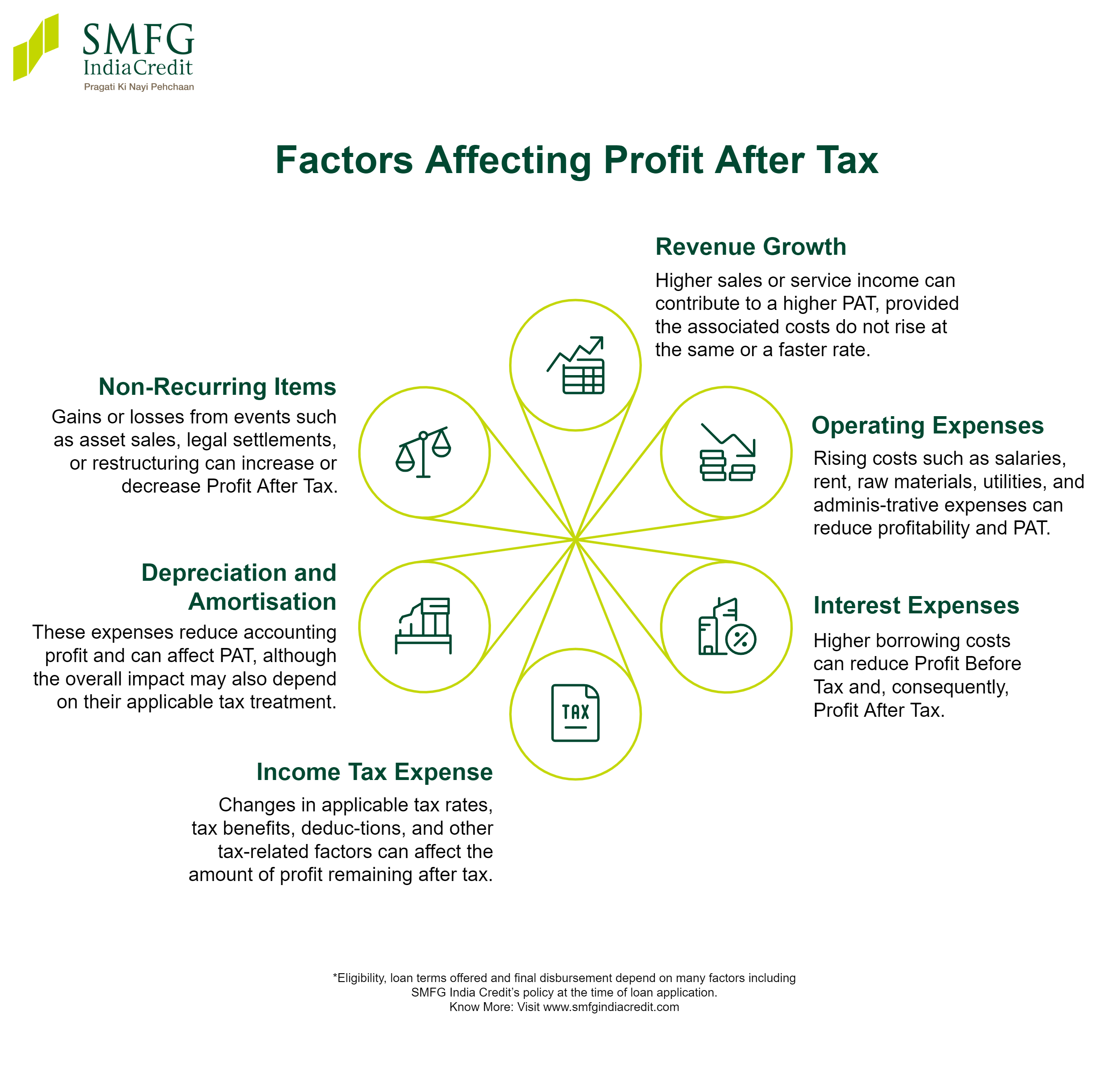
Several financial and operational factors can influence a company's Profit After Tax. Since PAT is determined after accounting for expenses, finance costs, and income tax, changes in revenue, costs, or tax expense can affect the final figure.
Some of the key factors include:
- Revenue growth: Higher sales or service income can contribute to a higher PAT, provided the associated costs do not rise at the same or a faster rate.
- Operating expenses: Rising costs such as salaries, rent, raw materials, utilities, and administrative expenses can reduce profitability and PAT.
- Interest expenses: Higher borrowing costs can reduce Profit Before Tax and, consequently, Profit After Tax.
- Income tax expense: Changes in applicable tax rates, tax benefits, deductions, and other tax-related factors can affect the amount of profit remaining after tax.
- Depreciation and amortisation: These expenses reduce accounting profit and can affect PAT, although the overall impact may also depend on their applicable tax treatment.
- One-time or non-recurring items: Gains or losses from events such as asset sales, legal settlements, or restructuring can increase or decrease Profit After Tax for a particular accounting period.
Limitations of Using PAT Alone
Although Profit After Tax is an important measure of profitability, it should not be used as the only indicator of a company's financial health. Analysing PAT alongside other financial metrics can provide a more balanced view of business performance and financial position.
Some limitations of relying solely on PAT include:
- Does not reflect cash flow: A company may report a healthy PAT while experiencing cash flow constraints, as accounting profit and actual cash movement are different.
- Affected by tax factors: Changes in tax rates, incentives, deductions, or exemptions can influence PAT and make comparisons across companies or periods less straightforward.
- Influenced by accounting methods: Depreciation methods, accounting estimates, and certain accounting policies can affect reported profit.
- May include one-time gains or losses: Non-recurring events, such as asset sales or restructuring costs, can affect PAT without reflecting the company's regular business performance.
- Does not fully explain operational performance: PAT alone does not show whether a change in profitability resulted from revenue growth, cost changes, finance expenses, tax-related factors, or a combination of these.
How Businesses Can Improve Profit After Tax
Improving Profit After Tax requires a combination of revenue growth, effective cost management, and sound financial planning. Businesses should focus on sustainable strategies rather than short-term profit increases.
Some practical ways to improve PAT include:
- Increase sales by expanding the customer base or introducing new products and services.
- Control operating expenses through efficient budgeting and cost optimisation.
- Improve productivity by investing in technology and process improvements.
- Reduce unnecessary borrowing to lower interest expenses.
- Optimise inventory management to minimise carrying costs and wastage.
- Use available tax incentives and deductions while complying with applicable tax laws.
- Regularly review financial performance and identify areas for operational improvement.
Conclusion
Profit After Tax provides a useful measure of a business’s profitability after expenses and taxes have been accounted for. Understanding how PAT is calculated, what affects it, and its limitations can help business owners assess financial performance and make more informed decisions.
For businesses considering external financing to support their growth plans, SMFG India Credit offers unsecured business loans of up to Rs. 1 crore* at competitive interest rates.
Before applying, use the business loan eligibility calculator to get an indicative estimate of the loan amount you may qualify for based on your financial details.
You can also use the business loan EMI calculator to estimate your monthly repayments for different loan amounts, interest rates, and tenures, helping you plan your repayment obligations before applying.