Discounted Cash Flow (DCF) is a cornerstone valuation technique in corporate finance, extensively used to estimate the intrinsic value of an asset based on its future cash flows and the time value of money. The DCF approach is preferred by investors, financial analysts, and corporate decision-makers because it captures the underlying economics of an investment rather than relying solely on market sentiment or relative ratios. By projecting future earnings and discounting them to the present using an appropriate discount rate, DCF allows for precise investment valuation, capital budgeting, and long-term strategic planning.
Historically, the DCF method has been adopted by major investment institutions, multinational corporations, and private equity firms to guide decisions about mergers, acquisitions, and infrastructure projects. Its popularity stems from its ability to incorporate both risk assessment and profitability analysis into a single framework. For investors seeking to understand the true value of a business or project, Discounted Cash Flow (DCF) offers unparalleled clarity, making it a vital tool in both financial planning and professional valuation.
What Is Discounted Cash Flow (DCF)?
Discounted cash flow is a financial method used to determine the present value of future cash flows generated by an asset, project, or business. In simple terms, DCF's meaning is tied to the principle that money available today is more valuable than the same amount received in the future due to its potential earning capacity. This principle, known as the time value of money concept, is central to modern finance.
Essentially, DCF measures the intrinsic worth of an investment by estimating its future cash flows and discounting them using a suitable discount rate, often the Weighted Average Cost of Capital (WACC). For example, receiving Rs. 100 today is more valuable than receiving Rs. 105 a year later if the opportunity cost or discount rate is higher than 5%.
In practice, the DCF model helps investors and corporate managers make informed decisions by providing a quantitative foundation for investment analysis, business valuation, and financial planning. By comparing the DCF value with the current market price, analysts can determine if an asset is undervalued, overvalued, or fairly priced, making it an essential tool for sound financial decision-making.
Where Can the Discounted Cash Flow Method Be Used?
The Discounted Cash Flow method is highly versatile and can be applied in multiple areas of finance:
- Business Valuation: Companies frequently use the DCF model to determine intrinsic worth during mergers and acquisitions, or fundraising. It forms a core part of DCF investment analysis because it quantifies how much a business is likely to earn in the future.
- Real Estate Investments: Developers and investors apply DCF analysis to determine the feasibility of projects, considering rental income and long-term appreciation.
- Stocks and Bonds: Investors use DCF in finance to identify undervalued securities and guide portfolio decisions. This remains one of the most widely accepted DCF uses.
- Equipment Purchases and Infrastructure Projects: One of the core DCF applications is for corporations evaluating capital expenditures to ensure profitable returns.
- Long-Term Projects and Capital Budgeting: By analysing the present value of future cash flows, DCF guides decision-making for projects spanning several years.
How Does Discounted Cash Flow Work?
Wondering how Discounted Cash Flow works? The DCF analysis usually involves the following steps:
- Forecasting Future Cash Flows: Analysts estimate the inflows expected from a project or business over several years. These cash flow projections consider revenue growth, operating expenses, taxes, and market trends.
- Determining the Discount Rate in DCF: Often, the WACC, which reflects the cost of debt and equity, is adjusted for the rate of return investors expect. Risk premiums are included to account for uncertainty.
- Discounting Cash Flows: Future earnings are converted to present value. For instance, Rs. 105 expected next year at a 5% discount rate equals Rs. 100 today, illustrating the time value of money concept.
- Summing the Present Values: The total DCF calculation provides the asset's intrinsic value, which can be compared with its cost or market price to guide investment decisions.
Additional Example: If a company expects Rs. 50,000 in cash inflows next year and Rs. 60,000 the following year with a 10% discount rate, the present values would be Rs. 45,455 and Rs. 49,587, respectively, summing to Rs. 95,042. This demonstrates how the DCF method accounts for both timing and risk.
Discounted Cash Flow Formula
The Discounted Cash Flow formula is expressed as:
DCF Formula = CF1/(1+r)1+CF2/(1+r)2+.......+CFn/(1+r)n
Where:
- CF = Cash Flow in a given year
- r = Discount Rate (commonly WACC)
- n = Number of periods
This DCF valuation formula forms the basis of a Discounted Cash Flow model, used extensively in financial modelling, investment analysis, and corporate finance. The choice of discount rate in DCF is critical, as it directly impacts the valuation outcome.
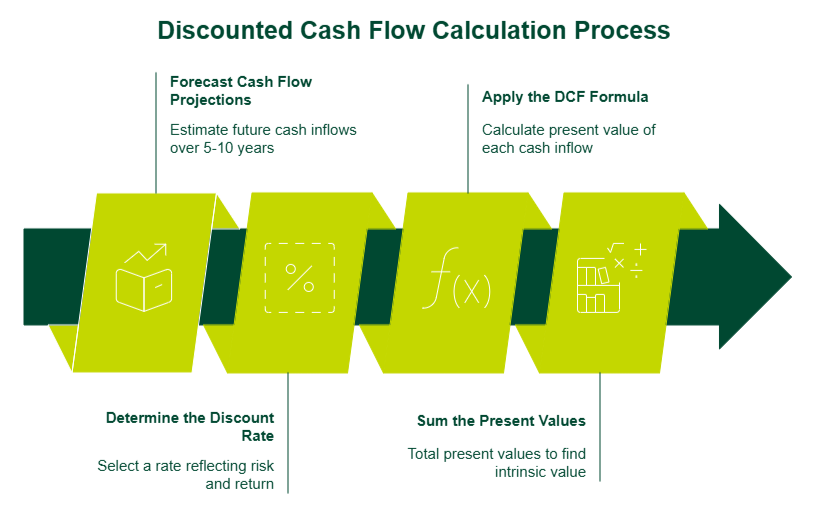
How to Calculate Discounted Cash Flow (Step-by-Step)
The DCF calculation steps are given as follows:
1. Forecast Cash Flow Projections
Estimate projected cash inflows for a 5–10 year period based on realistic assumptions.
2. Determine the Discount Rate
Select a discount rate reflecting WACC or required return, adjusted for risk.
3. Apply the DCF Formula
Calculate the present value for each projected inflow.
4. Sum the Present Values
The total represents the intrinsic value of the investment or business.
Discounted Cash Flow Example (5-Year Projection)
|
Year
|
Cash Flow (Rs)
|
Discount Rate
|
Approx. Present Value
|
|
1
|
100,000
|
10%
|
90,909
|
|
2
|
150,000
|
10%
|
124,793
|
|
3
|
200,000
|
10%
|
160,925
|
|
4
|
250,000
|
10%
|
191,079
|
|
5
|
300,000
|
10%
|
203,857
|
In this DCF example in finance, the total present value of Rs. 771,564 represents the asset’s fair value today. Such detailed calculation steps are essential for reliable investment valuation and financial planning.
Advantages of Discounted Cash Flow Model
Here’s why using the DCF analysis is important:
- Time Value of Money Consideration: Ensures precise valuation.
- Flexibility: Can model different growth scenarios and risk assessments.
- Wide Applicability: Useful across sectors from investment valuation and risk assessment to profitability
- Risk-Adjusted Evaluation: Discount rate adjustments allow the incorporation of uncertainty.
- Informed Capital Budgeting Decisions: Provides a strong foundation for long-term planning and investment decisions.
These advantages of DCF make it a critical tool for investors and managers seeking to optimise returns.
Limitations of Discounted Cash Flow Model
- Highly Sensitive to Assumptions: Minor changes in discount rate or growth can significantly alter results.
- Forecast Uncertainty: Long-term cash flow projections are inherently uncertain.
- Complexity: Requires expertise in financial modelling.
- Influenced by External Factors: Economic conditions, inflation, and market volatility affect the reliability of valuations.
Understanding these DCF disadvantages ensures more cautious and informed decision-making.
DCF vs Other Valuation Methods
|
Method
|
Basis
|
Strength
|
Limitation
|
|
DCF Method
|
Present value of future cash flows
|
Intrinsic valuation considers risk
|
Sensitive to assumptions
|
|
P/E Ratio
|
Price relative to earnings
|
Simple comparison
|
Ignores future cash flows
|
|
P/B Ratio
|
Price relative to book value
|
Useful for asset-heavy firms
|
Less relevant for service companies
|
|
Net Present Value (NPV)
|
Project-level returns
|
Strong in capital budgeting
|
Limited scope vs DCF
|
This comparison, highlighting DCF vs NPV and DCF vs other methods, demonstrates why the Discounted Cash Flow method of valuation is considered one of the most comprehensive approaches. It not only factors in future cash flows and the time value of money but also incorporates risk, making it well-suited for investment valuation.
Applying DCF Insights to Smarter Business Loan Decisions
Understanding the true value of future earnings does not just help with investments; it can also strengthen borrowing decisions. When entrepreneurs evaluate projected cash flows using DCF sensitivity analysis, they gain clearer visibility into whether taking a business loan can be feasible.
Entrepreneurs who can demonstrate strong future cash flow projections and creditworthiness are also better positioned to secure competitive business loan interest rates. A business loan eligibility calculator can be used to assess borrowing capacity in advance, while a business loan EMI calculator helps plan repayments in line with projected cash flow, ensuring more confident long-term financial planning.
Conclusion
The Discounted Cash Flow method is a fundamental valuation framework, combining risk, time value, and profitability into one comprehensive analysis. By estimating the present value of future cash flows, DCF provides clarity on the intrinsic worth of businesses, investments, and projects. Its flexibility, applicability across industries, and ability to guide business valuation and capital budgeting decisions make it indispensable in corporate finance.
Looking to improve your cash flow? SMFG India Credit offers collateral-free business loans of up to Rs 75 lakhs* at competitive interest rates. Simply prepare the required business loan documents, review your business loan eligibility, and apply online for a seamless borrowing journey.
* Please note that this article is for your knowledge only. Loans are disbursed at the sole discretion of SMFG India Credit. Final approval, loan terms, disbursal process, foreclosure charges and foreclosure process will be subject to SMFG India Credit's policy at the time of loan application. If you wish to know more about our products and services, please contact us