E-business, or electronic business, has become a central part of modern commerce, and you now see it everywhere, from shopping, travel bookings, and digital lending to how small firms manage daily tasks. When you look at any online business model, you will notice how it uses the Internet to run, deliver value, and stay competitive. Today, an e-business helps you reach people faster, cut costs, and run your work in a smooth and organised way. To understand the e-business meaning, think of it as running your business using the Internet and digital tools.
What Is e-Business?
E-business simply means carrying out operations online instead of relying only on physical stores or paperwork. In an electronic business, everything, including marketing, payments, customer service, and back-end processes, happens through digital channels. This is different from a traditional business model because you depend more on technology than physical presence, making the e-business meaning clear and practical.
Examples of e-Business
You come across e-businesses every day. Some familiar e-business examples include:
- Amazon: Global online retailer offering a wide range of consumer goods.
- Flipkart: Indian online marketplace.
- Ola and Uber: Ride-hailing e-business models.
- MakeMyTrip: Online travel and hotel booking platform.
- Zomato and Swiggy: Food delivery platforms.
- Net banking and UPI apps: Part of the digital business ecosystem, enabling online transactions.
- OTT Platforms like Netflix: Provide subscription-based entertainment through the Internet.
Features of e-Business
Here are the core features of e-business that define how these platforms work:
- Online communication with customers
- Digital payment systems
- Reduced physical paperwork
- Real-time order tracking
- Data-driven decision-making
- Automated operations
- Accessible from any device
- Online marketing integrations
- Lower operational costs
- Wider reach across cities and countries
You will notice these features of an online business when you interact with any digital store or service.
Components of e-Business
To understand the structure, here are the main components of e-business that keep it running:
- e-commerce (Buying and selling online)
- Customer Relationship Management (CRM)
- Enterprise Resource Planning (ERP)
- Supply Chain Management (SCM)
These systems support the e-business process and help a firm manage customers, orders, and internal tasks. Many companies also use e-business software to connect these systems so they can work together.
Benefits of e-Business
Some key advantages of electronic business that make it useful for all enterprise sizes are:
- Global reach
- Lower operational costs
- Easier communication with customers and partners
- Faster order processing and service delivery
- Better customer understanding through data
- High scalability as the business grows
- Ability to operate 24/7 without geographical limits
- Less dependency on physical space
These benefits of e-business show the importance of electronic business for all sectors, from SMEs (Small and Medium Enterprises) and startups to large corporations.
Functions of e-Business
Each function of electronic business helps you understand how value is created digitally:
- Collecting and sharing information
- Matching customer needs with products
- Facilitating online transactions
- Coordinating supply chains
- Managing customer support
- Handling returns and refunds
- Recording data for reporting
- Marketing through digital channels
How Does e-Business Work?
To understand how e-business works, picture a simple digital transformation system:
- A website or mobile app that displays products or services
- A secure digital payment method for completing transactions
- A support channel to assist customers through chat, email, or calls
- A delivery or fulfilment system that processes and ships orders
- A dashboard that allows the business to track orders, payments, inventory, and performance
E-business uses digital infrastructure to handle shopping, communication, and service delivery from start to end.
Types of e-Business
There are several types of e-business, each defined by how buyers and sellers interact online. The most common types of online business models and e-business applications include:
- B2B: Businesses selling to other businesses
- B2C: Most common; online stores selling to customers
- C2C: Platforms like OLX or eBay
- C2B: Freelancers offering services
- B2G: Businesses offering services to the Indian government
- Mobile Commerce: Buying and selling through mobile apps and smartphones
- Social Commerce: Selling products and services through social media platforms
- Online Marketplace: E-commerce platforms like Amazon or Flipkart
Challenges of e-Business
Some common challenges of e-business include:
- Cybersecurity risks and vulnerability to online fraud
- Integration issues when connecting multiple digital systems or software
- Lack of skilled staff to manage technology, analytics, and digital transformation
- High competition due to low entry barriers in online markets, hindering business growth
- Frequent technology updates that require investment and adaptation
- Data privacy concerns related to customer information and compliance
- Delivery and logistics delays affecting customer experience
These challenges of e-business affect both MSMEs and large companies.
E-Business vs E-Commerce
Here is the difference between e-commerce and e-business:
|
Feature
|
E-Business
|
E-Commerce
|
|
Scope
|
Broad
|
Part of e-business
|
|
Activities
|
Sales, marketing, CRM, ERP, SCM, and other business functions
|
Majorly buying and selling
|
|
Processes
|
End-to-end business operations
|
Focused on online transactions
|
|
Technology use
|
Wider digital systems such as websites, apps, ERP, CRM, SCM, automation, and analytics
|
Mainly websites and apps for online purchases
|
|
Example
|
Amazon managing logistics, marketing, CRM, customer support, warehousing, and operations
|
Buying a product on Amazon
|
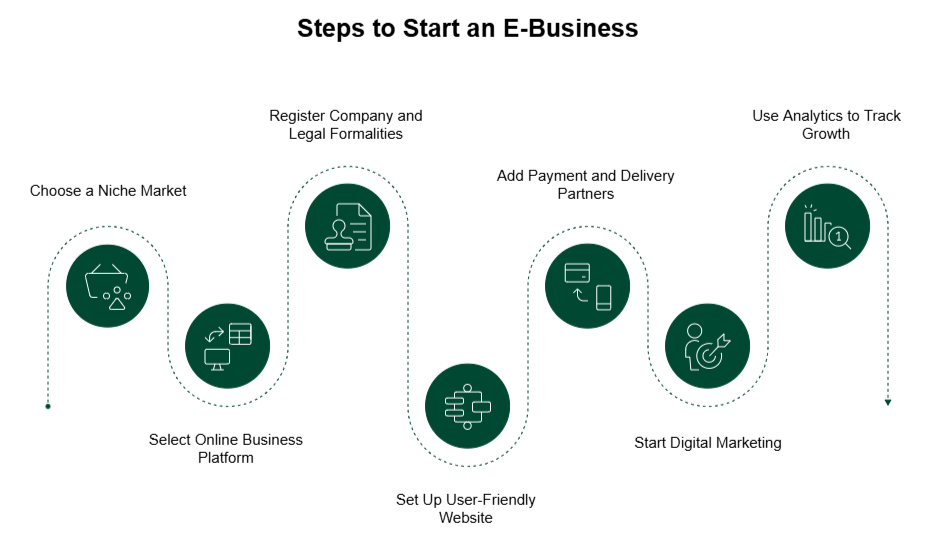
How to Start an e-Business in 7 Steps
If you want to begin your own digital venture and are wondering how to start an online business, here are the typical steps to start an e-business:
- Choose a niche market.
- Select the right online business platform.
- Register your company and complete the required legal formalities.
- Set up a user-friendly website.
- Add trusted payment and delivery partners.
- Start digital or online marketing.
- Use analytics to track growth and evaluate performance.
Limitations of e-Business
Here are some major limitations of e-business:
- Higher risk of online fraud and cyberattacks
- Heavy dependence on Information Technology and Internet connectivity
- Possible delays in delivery and logistics during peak demand or disruptions
- Limited personal interaction, which may affect customer trust and loyalty
- Need for regular updates and maintenance of digital systems
- Data privacy and cybersecurity challenges that require strong protection measures
These limitations of e-business cannot be ignored when planning for growth, and enterprises must invest in secure technology, customer support, and operational efficiency to overcome them.
Why You Need a Business Loan for e-Business
Even a well-established e-business requires steady investment to operate smoothly and scale. A business loan can help fund areas such as technology upgrades, inventory expansion, improved logistics, and hiring skilled staff for customer support or digital operations. For small and medium enterprises, a tailored SME loan can also be useful when adding new product lines, integrating advanced tools like Artificial Intelligence (AI), blockchain, and big data, or strengthening cybersecurity.
It is wise to compare business loan interest rates and other terms before borrowing to ensure the most cost-efficient funding. You can also use a business loan EMI calculator to estimate monthly instalments and choose a repayment structure that aligns with your cash flow.
Must Read: Minimum CIBIL Score for Business Loans
Security and Risks of e-Business
Here are common security issues in e-business:
- Phishing attacks
- Malware
- Payment fraud
- Data theft
- Weak authentication
- Poor encryption
To manage security in e-business, you should update systems regularly and follow compliance rules.
Future Outlook for e-Business
The future trends in e-business point towards:
- Use of Artificial Intelligence (AI)
- Use of blockchain
- Growth in mobile commerce
- Growth of social commerce
- Rise of cloud computing
- Wider use of digital payments
- Dependence on big data
- Wider adoption of Information Technology by SMEs
- Better customer experience
- More opportunities for startups
- Growth of the MSME and SME sectors
- More presence in the global market
You will see these shifts becoming stronger as digital transformation in business accelerates worldwide. Taken together, these patterns highlight the expanding scope of e-business in India and the significant e-business opportunities that lie ahead for organisations of all sizes.
Conclusion
E-business enables companies to run operations smoothly, reach customers across the world, manage processes digitally, and scale at their own pace. When you understand its meaning, types, components, benefits, and challenges, you can apply this model more effectively and build long-term efficiency.
If you are planning to grow your digital venture and build a strong internet-based business, you may consider an unsecured business loan of up to Rs 75 lakhs* from SMFG India Credit. We offer competitive interest rates and flexible repayment tenures of up to 60 months*. Check your borrowing potential using our business loan eligibility calculator, prepare the required business loan documents, and apply online today!
* Please note that this article is for your knowledge only. Loans are disbursed at the sole discretion of SMFG India Credit. Final approval, loan terms, disbursal process, foreclosure charges and foreclosure process will be subject to SMFG India Credit's policy at the time of loan application. If you wish to know more about our products and services, please contact us