Trading business ideas in 2026 are drawing increasing attention from aspiring Indian entrepreneurs, and the reasons are easy to see. E-commerce penetration is deeper than ever, digital payments now reach every town and village, and wholesale suppliers are accessible through online platforms that were not widely available a few years ago. Whether you want to run a trading business in India from a small shop, sell on Amazon and Flipkart, or scale a full distribution network, the barrier to entry has become significantly lower.
This guide walks you through profitable trading business ideas in India you can explore in 2026, the investment needed, the legal steps involved, and the practical tips for success.
What Is a Trading Business?
The trading business meaning refers to a business where you buy finished goods from a producer or wholesaler and sell them to the end customer or to another business, earning the margin between your purchase price and selling price. Your role is to move goods from where they are produced to where they are needed, adding value through sourcing, logistics, and sales.
What the trading business is comes down to this single idea: match supply with demand and take a profit for doing so. A trading entrepreneur example would be a person who buys cotton t-shirts in bulk from a Tirupur factory at ₹120 per piece and sells them online at ₹299 per piece, earning the difference as gross margin. The trading business model can be wholesale, retail, online, offline, or a mix of all three.
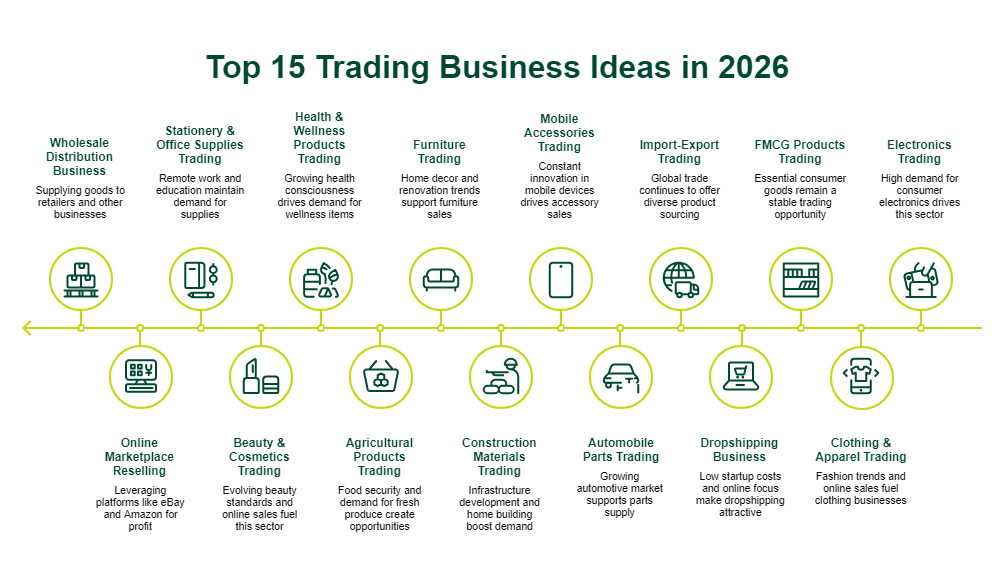
Top 15 Trading Business Ideas in 2026
Here is a curated list of trading business ideas covering online, offline, and hybrid models, each suited to different budgets and interest areas. The best trading business ideas in 2026 cover a mix of everyday essentials, emerging consumer trends, and export opportunities. Whichever option you pick, success depends on picking the right supplier, staying sharp on margins, and keeping pace with trading business trends.
Electronics Trading Business
Electronics trading is one of the largest and most consistent categories in India. You source mobile phones, laptops, small appliances, chargers, and audio devices from authorised distributors or open-market importers, and sell them through your shop, your own website, or marketplaces. Pros of an electronic items business include:
- Steady demand through festive seasons and upgrade cycles
- Easy to start with a narrow range and expand as you grow
- Clear supplier network across metropolitan hubs
Clothing and Apparel Trading
A clothing trading business fits well for first-time entrepreneurs because sourcing is flexible and customer demand is year-round. You can buy from wholesale hubs like Surat, Tirupur, and Ludhiana, then sell through an Instagram store, your own website, or marketplaces. Strong visuals and fast shipping matter more than a large catalogue when you start.
FMCG Products Trading
An FMCG trading business deals in fast-moving consumer goods like packaged food, personal care, household cleaning, and beverages. This kind of grocery trading business runs on volume rather than margin. What makes this a reliable trading business in India is repeat buying. A store or kirana owner who becomes your regular customer will keep reordering every week.
Dropshipping Business
A dropshipping business in India is built around a zero-inventory model. You list products on your store, take the customer order, and forward it to a supplier who ships the item directly to the buyer. Platforms like Shopify make setup quick. This is one of the lowest-capital entries among online trading business ideas, since you do not hold stock. The trade-off is thinner margins and less control over shipping time.
Import-Export Trading
An import export business idea connects you to international markets. You can import electronics, consumer goods, or industrial items from China, Vietnam, and Turkey, or export Indian textiles, handicrafts, spices, and agri-products to the Middle East, Europe, and Africa. An international trading business needs an Import Export Code (IEC) from DGFT, proper customs documentation, and a grasp of freight and duty calculations.
Automobile Parts Trading
India has a very large number of registered vehicles, and every one of them needs parts and consumables over time. An auto parts trading business covers spares, lubricants, tyres, batteries, filters, and accessories. Demand comes from workshops, fleet operators, and retail customers. Location matters: a shop near a mechanic cluster or a transport hub will outperform a standalone setup in a residential area.
Mobile Accessories Trading
The mobile accessories business is one of the highest-margin trading businesses because products are small, and inventory is cheap. A phone accessories trading range typically includes cables, chargers, power banks, earphones, back covers, screen protectors, and holders. You can source from wholesale markets in Gaffar (Delhi), Ritchie Street (Chennai), or Manish Market (Mumbai), or from importers directly.
Construction Materials Trading
A construction material trading business is built for volume. You deal in cement, steel, tiles, sand, bricks, paint, plumbing fittings, and electrical goods. The building materials business serves builders, contractors, and individual home-owners. You need storage space, transport, and credit relationships with both suppliers and customers to run this successfully.
Furniture Trading
A furniture trading business sells ready-made and customised furniture to homes, offices, and rental property owners. You can source from manufacturing clusters in Jodhpur, Saharanpur, and Kirti Nagar in Delhi, and sell through a showroom, website, or marketplaces.
Agricultural Products Trading
An agriculture trading business connects farmers with urban buyers through mandis, direct sourcing, or contract arrangements. Common categories include grains, pulses, spices, fresh fruits and vegetables, and organic produce. Farm produce business margins depend heavily on shelf life and logistics, so start with non-perishables like pulses or turmeric before moving to fresh produce.
Health and Wellness Products Trading
A health products business is riding a durable consumer trend. You can trade in nutraceuticals, protein supplements, ayurvedic products, fitness equipment, and wellness gadgets. A supplement trading business needs FSSAI registration for any ingestible products, and care with regulatory compliance since health claims are tightly monitored.
Beauty and Cosmetics Trading
The cosmetics trading business in India is driven by influencer marketing and fast-changing trends. The beauty products business does well on Instagram, YouTube, and dedicated beauty marketplaces like Nykaa. Compliance with BIS and FSSAI norms (for some categories), a strong social media presence, and fast reorder cycles on bestsellers are the three pillars of this category.
Stationery and Office Supplies Trading
A stationery trading business serves schools, colleges, offices, and retail customers with steady year-round demand. The office supplies business typically stocks notebooks, pens, files, printer cartridges, sticky notes, and paper. A school supplies business typically sees a big spike around the academic session start in April-June.
Online Marketplace Reselling
A reselling business in India is one of the fastest ways to start with minimal capital. You list products on Amazon, Flipkart, or similar platforms and resell items you have sourced from wholesalers or through dropshipping tie-ups. The online reselling business lets you test categories quickly without long-term inventory commitments.
A Flipkart/Amazon seller business does need you to manage returns, fulfilment SLAs, and platform fees carefully, as thin margins get eroded by operational slippage. This is one of the most accessible small trading business ideas for first-time sellers.
Wholesale Distribution Business
A wholesale trading business is a higher-capital option where you buy from manufacturers in bulk and sell to retailers at a markup. As a distribution business in India, you typically cover a defined territory for a brand and earn a fixed margin per unit sold.
Bulk trading business works on tight margins, but large volumes, and success depends on relationships with both the supplier and the retail business network. This is one of the most durable trading business examples when you have the capital and the patience to build a distribution footprint over 12 to 24 months.
These were the top business ideas in India currently seeing traction across urban and tier-2 markets.
How to Start a Trading Business in India
Here are the typical trading business registration steps most Indian entrepreneurs follow:
- Research your chosen product category, target customer, and competition.
- Work out a rough margin and cash-flow plan for the first six months.
- Register your business (sole proprietorship, LLP, or private limited).
- Complete GST registration if your expected turnover crosses the threshold.
- Apply for MSME registration on the Udyam portal for access to government benefits.
- Open a current account and set up the digital payments infrastructure.
- Identify and onboard reliable suppliers, negotiating payment terms.
- Build your sales channel, whether a physical shop, website, or marketplace listing.
- Start with a small stock, test the market, and then scale based on actual demand.
Investment Required for Trading Business
Your startup capital depends largely on the category you pick. A low-investment trading business, like online reselling or dropshipping, can start with ₹25,000 to ₹1 lakh. A physical retail shop for clothing or accessories typically needs ₹3 lakh to ₹10 lakh. Wholesale and construction materials trading can cross ₹25 lakh to ₹1 crore in working capital.
Here is an indicative range:
|
Trading Business Type
|
Investment Level
|
|
Dropshipping / Online Reselling
|
Low
|
|
Mobile Accessories
|
Low to Moderate
|
|
Clothing / Apparel
|
Moderate
|
|
Electronics (Small Shop)
|
Moderate to High
|
|
FMCG Distribution
|
High
|
|
Construction Materials
|
High
|
|
Import-Export
|
High
|
Please note that these figures are indicative. The actual investment required may vary based on factors such as location, scale of operations, supplier terms, inventory levels, and infrastructure requirements.
Legal Requirements and Licences
Running a compliant trading business in India needs a few core registrations in place before you start selling:
- Business Registration: Sole proprietorship, partnership, LLP, or private limited, depending on scale and partners.
- GST Registration: Mandatory when your annual turnover exceeds ₹40 lakh for the supply of goods (₹20 lakh for services, ₹10 lakh in special category states).
- MSME Registration: Free Udyam registration gives you access to priority sector lending, tailored MSME loans, and protection under the MSMED Act.
- Trade Licence: Issued by your local municipal body, required for most retail and wholesale establishments.
- Shop and Establishment Act Registration: State-specific, covers working hours, employee records, and premises.
- FSSAI Licence: Mandatory for food, beverage, and nutraceutical trading.
- IEC Code: Required for import export business activity, issued by DGFT.
- Current Account and PAN: In the name of the business entity.
Key Factors to Consider Before Starting
Before you commit capital to any trading business idea, think through these decisions carefully:
- Capital Available: Match your category to your actual funds, not your aspirations.
- Market Demand: Check real demand in your target area, not just national trends.
- Supplier Reliability: Meet at least three potential suppliers and verify their credibility before finalising.
- Storage and Logistics: Factor in godown rent, packaging, and transport in your cost sheet.
- Legal Compliance: Ensure all registrations are in place before the first sale.
- Competition: Study at least five existing players in your area or category, and identify what you can do differently.
- Payment Terms: Negotiate credit from suppliers and clear terms with buyers to protect your cash flow.
These practical trading business tips can help you make informed decisions and build a stronger foundation.
Online vs Offline Trading Business
Each model suits different goals, budgets, and temperaments. Here is a side-by-side ecommerce vs traditional business comparison:
|
Factor
|
Online Trading Business
|
Offline Trading Business
|
|
Startup cost
|
Low to moderate
|
Moderate to high
|
|
Reach
|
Pan-India from day one
|
Local to regional
|
|
Overheads
|
Platform fees, shipping, marketing
|
Rent, electricity, staff
|
|
Customer interaction
|
Digital only
|
Face-to-face
|
|
Inventory need
|
Can be nil (dropshipping)
|
Physical stock always needed
|
|
Best for
|
First-time sellers, niche products
|
Local markets, bulky goods
|
|
Examples
|
Amazon, Flipkart, Meesho sellers; Shopify stores
|
Retail shops, wholesale distributors
|
Many successful Indian traders run a hybrid model, using a physical shop for local walk-ins and online marketplaces for wider reach. This is one of the most effective patterns across the trading business examples seen in tier-2 cities.
Tips to Succeed in the Trading Business
Here are some successful trading business strategies that often separate struggling traders from profitable ones:
- A slightly costlier supplier who delivers on time is worth more than a cheap one who lets you down.
- Include shipping, GST, platform fees, returns, and packaging before setting your trading business profit margin.
- Reinvest early profits into inventory and marketing, not personal expenses.
- Track bestsellers weekly and double down on fast movers instead of spreading thin across slow stock.
- Build repeat customers through WhatsApp follow-ups, loyalty offers, and service quality.
- Keep your GST and accounting records clean from month one, so scaling does not create chaos later.
- What sold well in 2024 may not sell in 2026, and spotting changes early protects your margin.
How a Business Loan Can Support Growth
After the initial setup phase, a small business loan can help you scale operations, increase inventory, and expand into new markets without disrupting your working capital. It allows you to take larger orders, improve supplier terms, and invest in better logistics or marketing.
However, before applying, review the business loan eligibility criteria carefully. Most lenders typically require at least three years of business operations, along with stable financial records and a satisfactory credit profile to assess repayment capacity.
To plan repayments effectively, use a business loan EMI calculator to estimate monthly outflows. This helps you align loan repayments with your cash flow and avoid strain while growing your trading business.
Conclusion
A trading business remains one of the most practical paths to entrepreneurship in India. The model is straightforward, the capital requirement can be aligned with your budget, and the learning curve is manageable for first-time business owners. Choose a category you can source efficiently, complete your registrations, maintain disciplined margins, and reinvest early gains into growth. The best trading business in India for you is one you can understand quickly and scale with consistency.
If you are looking to expand your operations, consider an business loan of up to Rs. 1 crore* from SMFG India Credit. Eligible businesses can benefit from competitive interest rates and flexible tenures of up to 60 months*.
Use the business loan eligibility calculator to estimate your borrowing capacity and apply online today.
* Please note that this article is for your knowledge only. Loans are disbursed at the sole discretion of SMFG India Credit. Final approval, loan terms, disbursal process, foreclosure charges and foreclosure process will be subject to SMFG India Credit's policy at the time of loan application. If you wish to know more about our products and services, please contact us