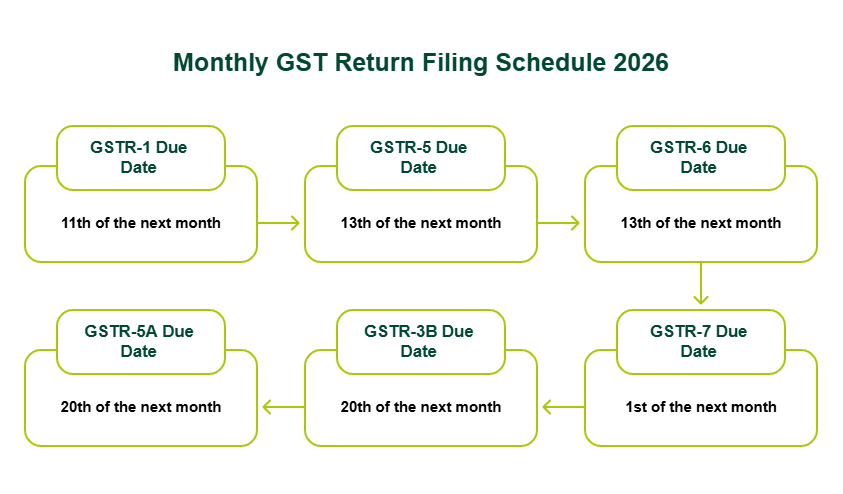
Tracking the GST return due date helps your business stay compliant and avoid penalties. Maintaining a GST filing calendar in India can make it easier to monitor the specific deadlines applicable to registered taxpayers, as missing them may result in late fees, interest charges, and compliance notices. This GST compliance schedule covers all key due dates for 2026, so you know exactly when to file and the possible consequences of missing a deadline.
What Are GST Returns?
A GST return is a document you file on the GST portal to report your sales, purchases, tax collected, and tax paid for a specific period. Under the Goods and Services Tax system, every registered taxpayer must submit these filings periodically. It is a legal requirement under GST return filing rules, and it helps the government verify that the correct amount of tax has been collected and paid across the supply chain.
Why GST Return Due Dates Matter for Businesses
Missing the GST return due date can have several financial and operational consequences:
- Late fees and interest: Miss the due date for the GST return, and you face a fine of Rs. 50 per day in late fees, plus 18% per annum interest on the outstanding tax amount.
- ITC disruption: Delayed filing blocks your buyers from claiming Input Tax Credit.
- Bill blockages: Non-compliance can restrict bill generation and disrupt your supply chain.
- GST registration cancellation: Repeated non-filing can lead to suspension or cancellation of your registration.
Timely filing and maintaining accurate records can also support better financial documentation, making it easier to organise the business loan documents required when applying for external financing.
Types of GST Returns Businesses Must File
|
GST Return
|
Who Files It
|
Frequency
|
|
GSTR-1
|
All regular taxpayers
|
Monthly / Quarterly
|
|
GSTR-3B
|
All regular taxpayers
|
Monthly / Quarterly
|
|
GSTR-4
|
Composition scheme taxpayers
|
Annually
|
|
GSTR-5 / GSTR-5A
|
Non-resident taxpayers; OIDAR service providers
|
Monthly
|
|
GSTR-6
|
Input Service Distributors
|
Monthly
|
|
GSTR-7
|
TDS deductors
|
Monthly
|
|
GSTR-8
|
E-commerce operators collecting TCS
|
Monthly
|
|
GSTR-9
|
All regular taxpayers
|
Annually
|
|
GSTR-9C
|
Turnover above Rs. 5 crore
|
Annually
|
|
GSTR-10
|
Taxable persons filing a final return on cancellation/surrender of GST registration
|
One-time
|
|
GSTR-11
|
UIN holders claiming a refund
|
Monthly
|
|
ITC-04
|
Manufacturers or principals sending/receiving goods from job workers
|
Half-yearly if turnover > Rs. 5 crore; annually if turnover ≤ Rs. 5 crore)
|
|
CMP-08
|
Composition scheme taxpayers
|
Quarterly
|
GST Return Due Dates for 2026
The GSTR due dates you need to follow depend on your taxpayer category and the state where your business is registered. Always check the GST portal for any CBIC-notified extensions.
Monthly GST Return Due Dates 2026
The monthly GST return filing dates for the applicable forms are as follows:
|
Return Type
|
GST Due Dates
|
|
GSTR-1
|
11th of the next month
|
|
GSTR-3B
|
20th of the next month
|
|
GSTR-5
|
13th of the next month
|
|
GSTR-5A
|
20th of the next month
|
|
GSTR-6
|
13th of the next month
|
|
GSTR-7
|
10th of the next month
|
|
GSTR-8
|
10th of the next month
|
|
GSTR-11
|
28th of the month succeeding the tax period
|
Quarterly GST Return Due Dates 2026
The quarterly return due date GST structure helps smaller businesses manage their GST compliance schedule more easily.
|
Return Type
|
GST Due Dates
|
|
GSTR-1
|
13th of the month post the quarter
|
|
GSTR-3B
|
22nd (for Category X states) or 24th (for Category Y states) of the month post the quarter
|
|
CMP-08
|
18th of the month post the quarter
|
Category X states include Maharashtra, Gujarat, Karnataka, Tamil Nadu, and Andhra Pradesh, among others. Category Y states include Uttar Pradesh, Rajasthan, Punjab, and West Bengal, among others.
Annual GST Return Filing Deadlines
GSTR-9 is the annual return all regular taxpayers must file, covering total sales, purchases, input tax credit, and tax liability for the full year. The annual GST return due date is 31st December that follows the end of the financial year. For example, for FY 2025–26, the due date is 31st December 2026. Businesses with turnover above Rs. 5 crore must also file GSTR-9C by the same date. Composition dealers file GSTR-4 by 30th June, following the end of the financial year.
Timely GST compliance not only helps avoid penalties but also ensures better financial planning. Enterprises can use tools such as a business loan EMI calculator to better plan cash flow when accommodating funding needs alongside tax obligations.
*It is advisable to regularly refer to official notifications and updates on the GST portal or CBIC website to stay informed about any changes or extensions in deadlines, such as the GSTR-3B due date, as these may be revised from time to time.
GST Compliance Calendar for Business Owners
To simplify GST compliance for businesses, it is helpful to view all key return deadlines in one place. The table below provides a consolidated compliance calendar, covering monthly, quarterly, and annual filings along with their applicable due dates.
|
Return Type
|
Frequency
|
Due Date
|
|
GSTR-1 (Monthly)
|
Monthly
|
11th of the next month
|
|
GSTR-3B (Monthly)
|
Monthly
|
20th of the next month
|
|
GSTR-5
|
Monthly
|
13th of the next month
|
|
GSTR-5A
|
Monthly
|
20th of the next month
|
|
GSTR-6
|
Monthly
|
13th of the next month
|
|
GSTR-7
|
Monthly
|
10th of the next month
|
|
GSTR-8
|
Monthly
|
10th of the next month
|
|
GSTR-11
|
Monthly
|
28th of the next month
|
|
GSTR-1 (Quarterly - QRMP)
|
Quarterly
|
13th of the month following the quarter
|
|
GSTR-3B (Quarterly - QRMP)
|
Quarterly
|
22nd (Category X) / 24th (Category Y) of the month following the quarter
|
|
CMP-08
|
Quarterly
|
18th of the month following the quarter
|
|
GSTR-4
|
Annually
|
30th June following the financial year
|
|
GSTR-9
|
Annually
|
31st December following the financial year
|
|
GSTR-9C
|
Annually
|
31st December following the financial year
|
Penalties for Late GST Return Filing
Missing the GST return due date will cost you:
- Standard late fee: Rs. 50 per day, capped at Rs. 10,000.
- NIL return late fee: Rs. 20 per day, capped at Rs. 500.
- Interest: 18% per annum on outstanding tax from the due date for GST payment until actual payment.
GST penalty for late filing can add up quickly. Filing a NIL return on time is mandatory even for periods with zero transactions.
Tips for Managing GST Compliance Efficiently
- Mark every GST return due date on a calendar and set reminders a week in advance.
- Reconcile invoices regularly against GSTR-2A and GSTR-2B on the GST portal.
- Use reliable accounting software to automate GST filing and reduce manual errors.
- File NIL returns on time to avoid an unnecessary GST penalty.
- Check the GST portal for any changes in GSTR due dates before every filing cycle.
Common GST Filing Mistakes Businesses Should Avoid
GST filing may seem routine, but small errors can lead to penalties, notices, or delayed input tax credit claims. Many businesses struggle with avoidable mistakes that impact compliance and cash flow. Common errors include:
- Missing filing deadlines, leading to late fees and interest charges
- Claiming incorrect input tax credit or overlooking eligible claims
- Mismatch between GSTR-1 and GSTR-3B filings
- Not reconciling books with GST returns regularly
Being aware of these issues can help businesses stay on track and file returns accurately. This not only strengthens internal controls but can also improve credibility when applying for financing, increasing the chances of approval at competitive business loan interest rates.
Conclusion
From the GSTR-1 due date on the 11th of each month to the annual GST return due date of 31st December, every deadline in the GST compliance schedule plays an important role. Setting reminders ahead of each due date for GST payment and filing returns on time can help businesses avoid penalties and maintain a strong compliance record.
Consistent compliance also contributes to a reliable financial profile, which lenders consider when evaluating applications for credit products such as a business loan.
For enterprises managing growth alongside routine financial obligations, SMFG India Credit offers flexible business loans of up to Rs. 1 crore* without collateral. Use our business loan eligibility calculator to estimate your borrowing potential and apply online with ease.