The place of supply in GST (POS in GST) is a foundational concept that determines the taxable location of a transaction under India’s indirect tax regime.
Understanding what place of supply is in GST and the applicable place of supply rules in GST is essential for correct tax classification and compliance. Under the Indian GST (Goods and Services Tax) framework, the place of supply determines whether a transaction attracts CGST and SGST (in the case of intra-state supplies) or IGST (in the case of inter-state supplies).
Let’s delve further into the GST place of supply meaning.
Meaning of Place of Supply in GST
The place of supply definition in GST (Goods and Services Tax) refers to the state or union territory where a supply of goods or services is deemed to occur for taxation purposes. In simple terms, it identifies the location of consumption. The place of supply under the GST Act provides statutory rules to determine this location.
These GST transaction location rules are critical because they define whether a supply is intra-state or inter-state and determine the applicable tax components.
Importance of Place of Supply in GST
The importance of the place of supply under GST cannot be overstated. It plays a decisive role in determining tax liability, revenue allocation between states, and compliance accuracy. Since GST is a destination-based tax, the place of supply ensures that tax revenue accrues to the state where goods or services are consumed.
The role of the place of supply in tax liability becomes especially relevant in cross-border or multi-state transactions. Misidentifying the place of supply can lead to incorrect tax payments, such as charging CGST and SGST instead of IGST, or vice versa, resulting in compliance disputes. Under the prevailing GST law in India and gst council rules, businesses must accurately determine the place of supply to avoid penalties and ensure seamless claiming of Input Tax Credit (ITC).
How Place of Supply Determines Tax Type
The place of supply directly determines whether CGST and SGST (for intra-state supply) or IGST (for inter-state supply) will be levied under GST.
When the location of the supplier and the place of supply are in the same state, the transaction qualifies as an intra-state supply. In such cases, CGST and SGST are charged equally. Conversely, if the supplier and the place of supply are in different states, it constitutes an inter-state supply, attracting IGST.
Applying this principle ensures accurate GST tax applicability and revenue sharing between the central and state governments. Therefore, understanding the CGST vs IGST rule is essential for determining tax liability correctly.
Place of Supply Rules for Goods
The place of supply for goods under GST is governed primarily by statutory provisions dealing with movement and delivery. The GST place of supply for goods depends on whether the supply involves the movement of goods or not.
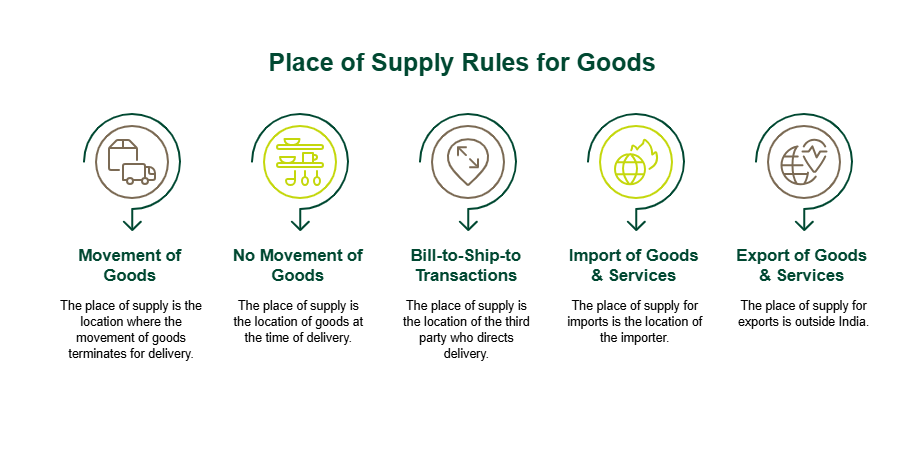
Key place of supply rules in GST for goods include:
- Movement of Goods: The place of supply is the location where the movement of goods terminates for delivery.
- No Movement of Goods: The place of supply is the location of goods at the time of delivery.
- Bill-to-Ship-to Transactions: The place of supply is the location of the third party who directs delivery.
- Import of Goods & Services: The place of supply for imports is the location of the importer.
- Export of Goods & Services: The place of supply for exports is outside India.
These goods supply location rules determine whether the supply qualifies as intra-state or inter-state and whether IGST, CGST, or SGST applies.
Place of Supply Rules for Services
The place of supply for services is more complex than goods under GST (Goods and Services Tax). Generally, the POS for services is the location of the recipient if registered, or the location of the supplier if unregistered.
Important GST supply service rules include:
- Registered Recipient: Place of supply is the recipient’s location.
- Unregistered Recipient: Place of supply is the supplier’s location.
- Performance-Based Services: Location where services are performed.
- Services Related to immovable property: Location of the property.
- Import of Goods & Services: Recipient’s location in India.
- Export of Goods & Services: Recipient located outside India.
These rules ensure clarity in service transaction location and prevent revenue leakage.
Place of Supply in Special Cases
Certain special place of supply cases are covered under specific provisions of GST (Goods and Services Tax). These include:
- Event Organisation and Admission: Place of supply is generally the location where the event is actually held.
- Passenger Transportation: Place of supply is typically the location where the passenger embarks on the conveyance for a continuous journey (for domestic transactions).
- Telecommunication Services: Place of supply depends on factors such as billing address, installation location, or the recipient’s address on record.
- Banking and Financial Services: Place of supply is generally the location of the recipient as per the records of the supplier.
Under these GST special rules, the place of supply may differ from the general provisions, depending on the nature of the service. Businesses must carefully evaluate each transaction under the GST law in India to ensure correct classification.
Example Scenarios of Place of Supply Under GST
Understanding the GST place of supply examples simplifies compliance and ensures correct tax classification.
Example 1: Goods Movement
A supplier in Maharashtra sells goods to a buyer in Gujarat. The POS in GST here is Gujarat. This is an inter-state supply attracting IGST.
Example 2: Intra-state Supply
A supplier and buyer are both located in Karnataka. The place of supply is Karnataka. CGST and SGST apply.
Example 3: Service Supply
A Delhi-based consultant provides services to a registered client in Tamil Nadu. The place of supply is Tamil Nadu, and IGST applies.
These real-world GST cases demonstrate how accurate determination of the place of supply directly impacts tax applicability and compliance.
Inter-State vs Intra-State Place of Supply
The distinction between inter-state supply and intra-state supply is determined by comparing the supplier location with the place of supply under GST.
If both are in the same state, it is an intra-state supply attracting CGST and SGST. If they are in different states, it is an inter-state supply attracting IGST. Therefore, the place of supply for interstate supply and the place of supply for intrastate supply concepts directly affect tax computation and compliance.
How to Determine the Place of Supply Under GST
Follow these GST place of supply steps to ensure correct tax classification:
- Identify whether the supply involves goods or services.
- Determine the supplier’s registered location.
- Apply relevant place of supply rules in GST for goods or services.
- Check if the transaction involves imports or exports.
- Compare the supplier location with the place of supply.
- Determine whether it qualifies as an intra-state supply or an inter-state supply.
- Apply appropriate tax – CGST, SGST, or IGST.
This structured approach ensures accurate GST place of supply compliance.
Place of Supply Rules for Digital and E-Commerce
The e-commerce place of supply GST provisions apply to digital services and online platforms. Under the digital services GST rules, the place of supply is generally the location of the recipient.
E-commerce operators facilitating supplies may be required to collect and remit tax under the GST Council rules. For online information and database access services, the place of supply for exports or the place of supply for imports provisions determine tax applicability.
Penalties for Incorrect Place of Supply
Incorrect determination of the place of supply under GST can lead to significant compliance issues. GST place of supply mistakes may result in:
- Payment of wrong tax type (CGST/SGST instead of IGST).
- Denial of Input Tax Credit (ITC).
- Interest and monetary penalties.
- Litigation under the GST law in India.
A GST penalty for incorrect supply often arises due to misinterpretation of statutory provisions or failure to evaluate special place of supply rules correctly.
Common Mistakes in Applying Place of Supply Rules
Frequent place of supply errors include:
- Incorrect classification of inter-state supply.
- Ignoring bill-to-ship-to provisions.
- Misunderstanding the place of supply for imports.
- Failure to identify service-specific rules.
- Overlooking the GST Council rules
Avoiding these common GST mistakes ensures smoother compliance.
Best Practices for Businesses
Enterprises should keep the following place of supply tips in mind:
- Maintain updated knowledge of the GST law in India.
- Review contracts to identify the transaction location.
- Implement automated GST place of supply validation.
- Conduct regular compliance audits.
- Train staff on the place of supply compliance tips.
Adopting these GST best practices reduces errors, limits exposure to interest and penalties, and strengthens overall compliance.
Conclusion
The place of supply in GST determines the tax jurisdiction and applicable tax components under India’s Goods and Services Tax regime. Understanding the place of supply meaning in GST, applying the correct statutory provisions, and ensuring GST compliance with accurate POS determination are essential for businesses operating across multiple states. Proper classification helps prevent disputes, safeguards Input Tax Credit (ITC) claims, and ensures adherence to legal requirements.
As your business manages these compliance obligations alongside routine expenses and growth initiatives, maintaining adequate working capital becomes crucial. To support your enterprise needs, SMFG India Credit offers unsecured business loans of up to Rs. 1 crore* at competitive interest rates. You can check your business loan eligibility in advance and use our EMI calculator and eligibility calculator to plan borrowing efficiently. Apply online with minimal business loan documentation or contact us for more information.