If you are planning to buy gold in India, you need to know how GST on gold works before you reach the billing counter. GST applies to the value of gold you purchase, the making charges on jewellery, and even the coins and bars you buy for investment. The gold GST rate India follows today has remained steady at 3% on the metal, with an additional 5% on making charges for jewellery.
This guide walks you through every tax component you will pay, the latest updates for 2026, and how the numbers add up on your bill.
Latest Update on GST on Gold in India (2026)
The most recent structural change to gold taxation came through the Union Budget 2024, when the government reduced total customs duties on gold from 15% to 6%, with the basic customs duty brought down from 10% to 5% and the Agriculture Infrastructure and Development Cess cut from 5% to 1%.
The GST 2.0 reforms announced at the 56th GST council meeting, effective from September 22, 2025, simplified tax slabs to 5%, 18%, and 40%, but the gold GST rate of 3% and the 5% on making charges remained untouched. So, for GST on gold in 2026, the numbers you pay at the counter are the same as last year.
What Is GST on Gold?
Goods and Services Tax (GST) on gold is the single tax you pay whenever gold changes hands in India, whether you buy jewellery, coins, or bars. Under Section 7 of the CGST Act, the supply of gold without any job work is treated as the supply of goods. Before GST was introduced in July 2017, gold transactions attracted VAT, excise duty, and service tax across different states, each at varying rates.
GST Rates on Gold Purchase in India
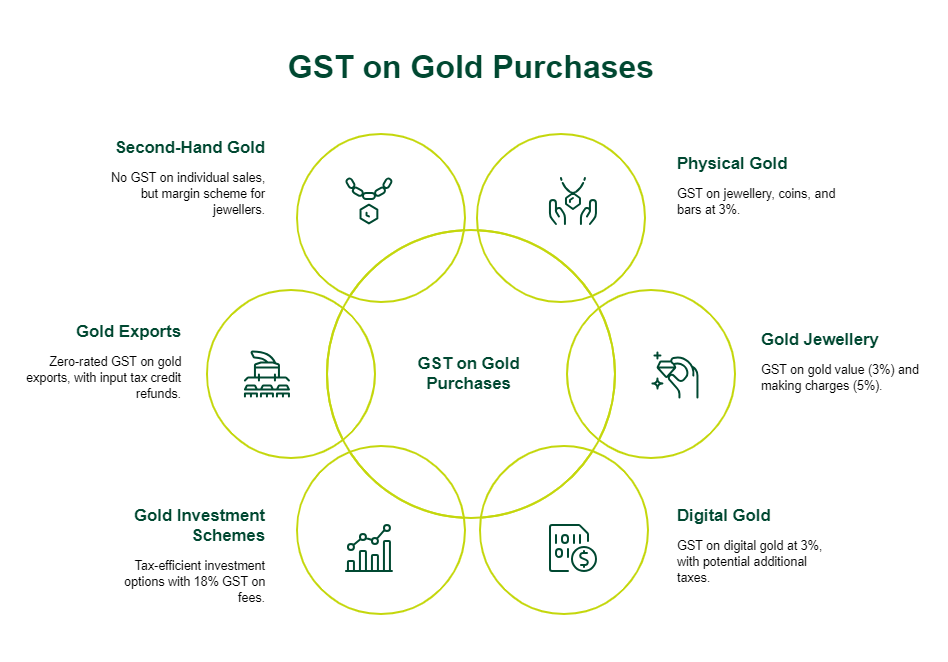
The current GST rate on gold in India is 3% on the value of gold, split equally as 1.5% CGST and 1.5% SGST. This rate applies to every form of gold you can buy, from a wedding necklace to a 10-gram coin. On top of this, a separate 5% GST is charged on the making charges when you buy jewellery. The earlier tax structure before 2017 included 1% VAT plus 1% service tax, which the 3% GST replaced.
Thus, as a GST for gold purchase of ₹1,00,000, you pay ₹3,000 as GST on the gold itself. If the jeweller has added making charges, that amount attracts an additional 5% GST. These two components together make up the total GST rate on gold you see on your invoice.
GST Rate Table on Gold
|
Component
|
GST Rate
|
Applies To
|
|
Gold value (bars, coins, jewellery)
|
3% (1.5% CGST + 1.5% SGST)
|
Purchase price of the gold
|
|
Making charges
|
5% (2.5% CGST + 2.5% SGST)
|
Labour, design, wastage on jewellery
|
|
Gold imports
|
3% IGST + customs duty
|
Imported gold, on assessable value
|
|
Digital gold
|
3%
|
Online purchase value
|
24-Carat Gold GST Rate in India (2026)
The 24-carat gold GST rate in India is 3% of the gold's value. Since 24K gold is the purest form available (99.9% purity), it is used mainly for bars, coins, and investment-grade products rather than jewellery, as pure gold is too soft to hold intricate designs.
The GST percentage stays the same at 3% whether you buy 22K or 24K, but the rupee amount of tax you pay is higher on 24K because the underlying gold value is higher. For example, if you buy a 24K gold coin worth ₹80,000, the GST on gold works out to ₹2,400.
22-Carat Gold GST Rate in India (2026)
The 22-carat gold GST rate in India is also 3%, identical to the 24K rate. 22K gold (91.6% purity) is the standard for jewellery because the added alloy makes it durable enough for daily wear. When you buy a 22K gold chain, you pay 3% GST on the value of the gold and 5% on the making charges separately.
So if the gold value in your ornament is ₹60,000 and the making charges are ₹9,000, your GST on gold jewellery adds up to ₹1,800 plus ₹450, taking the total tax component to ₹2,250.
GST on Physical Gold Purchase
GST on physical gold covers every tangible form of gold you can hold in your hand, including jewellery, coins, biscuits, and bars. A 3% GST applies to both 24-carat and 22-carat physical gold, and is charged at the point of sale by the registered jeweller or dealer. You pay this on the current market value of the gold on the day of purchase.
The tax appears as a separate line on your tax invoice, and any registered jeweller must issue a GST-compliant bill with CGST and SGST shown individually.
GST on Gold Coins and Bars
GST on gold bars and coins is the same 3% rate that applies to all other forms of physical gold. Unlike jewellery, coins and bars carry no making charges, so your invoice will show only the gold value plus the 3% GST on top. For example, a 10-gram 24K gold coin worth ₹95,000 attracts GST of ₹2,850.
Gold coins & bars are favoured for investment because the tax component is lower in absolute terms compared to jewellery, where making charges add a second layer of GST. Some jewellers issue promotional coins during festive seasons, but input tax credit is not allowed on gold coins given as promotional gifts or sales incentives.
GST on Gold Jewellery Making Charges
When you buy a ready-made ornament, GST on ready-made jewellery is charged in two parts: 3% on the gold and 5% on the making charges.
Making charges cover the labour cost, wastage allowance, and design complexity, and differ from one jeweller to another. For a ring where the gold value is ₹40,000 and the making charges are ₹5,000, you pay ₹1,200 as GST on the gold and ₹250 as GST on making charges, totalling ₹1,450.
GST on Digital Gold in India
Digital gold is gold that you buy online through apps or platforms, where the provider holds the physical metal in a vault on your behalf. Digital gold attracts 3% GST, the same rate as physical gold. When you place an order worth ₹5,000, you pay ₹150 as digital gold GST, and the platform credits the equivalent weight of gold to your account.
You can redeem this either as cash or by asking for physical delivery in the form of coins or bars. Keep in mind that delivery charges and storage fees, where applicable, may carry their own tax treatment, so read the platform's terms before you commit.
GST on Gold Investment Schemes
Gold investment schemes are taxed differently from physical gold. Gold ETFs, sovereign gold bonds, and gold mutual funds are not taxed on the gold itself, only on related service fees at 18%. This means when you invest in a sovereign gold bond issued by the Reserve Bank of India, you do not pay the 3% GST on gold investment that applies to a gold coin purchase.
You only pay GST on any management or service charges the scheme levies.
GST on Gold Exports from India
Gold exports from India are treated as zero-rated supplies under GST. At the 31st GST Council meeting on 22 December 2018, a GST exemption was announced for the supply of gold by a notified agency to registered gold jewellery exporters. This means exporters of gold jewellery do not pay GST on gold they source through notified agencies, which helps Indian jewellery stay competitive in international markets.
Registered exporters can also claim a refund of Input Tax Credit (ITC) on goods and services used in making the exported jewellery. Domestic buyers, however, do not get any relief under this provision, so the GST exemption on gold applies strictly to the export route.
GST on Second-Hand Gold
The treatment of GST on second-hand gold depends on the nature of the seller and the transaction. When individuals sell old gold, GST is generally not applicable, as they are not considered taxable suppliers under GST law. However, when a registered jeweller purchases such gold, GST implications may arise on resale, typically under the margin scheme, where tax is applied only on the value addition. These GST on gold in India rules ensure that tax is not levied multiple times on the same underlying gold value while maintaining compliance within the formal trade system.
GST Calculation on Gold Purchase
Here is a worked example of gold GST calculation for a 22K gold necklace:
|
Item
|
Amount (₹)
|
|
Gold value (10 grams at ₹6,500 per gram)
|
65,000
|
|
GST on gold at 3%
|
1,950
|
|
Making charges (12% of gold value)
|
7,800
|
|
GST on making charges at 5%
|
390
|
|
Total payable
|
75,140
|
The formula is straightforward: multiply the gold value by 3% to get the GST on the metal, then multiply the making charges by 5% to get the GST on the labour component. Add both to the base amounts, and you arrive at the final invoice total.
Please note that this is an illustrative example. Actual prices will vary based on prevailing gold rates and jeweller-specific charges.
Customs Duty on Gold Import in India (2026)
Following the July 2024 Union Budget, the total customs duty on gold fell from 15% to 6%, with the basic customs duty reduced from 10% to 5% and the Agriculture Infrastructure and Development Cess cut from 5% to 1%. Budget 2025 did not change these rates, keeping the duty at 6%. On top of this, a 3% IGST applies when gold is imported for commercial purposes, charged on the assessable value plus all customs duties.
The Government of India may revise these rates each Union Budget based on trade deficit concerns, smuggling trends, and domestic jewellery industry needs. The 2024 cut was introduced to curb smuggling and bring domestic gold prices closer to international rates. For Indian travellers returning from abroad with gold in excess of duty-free limits, the same 6% customs duty on gold applies at the airport, calculated on the value assessed by customs.
Difference Between Imported Gold and Domestic Gold Taxation
|
Parameter
|
Imported Gold
|
Domestic Gold
|
|
Basic customs duty
|
5%
|
Not applicable
|
|
Agriculture Infrastructure Cess
|
1%
|
Not applicable
|
|
GST / IGST
|
3% IGST on commercial imports
|
3% (1.5% CGST + 1.5% SGST)
|
|
Making charges GST
|
Not applicable at import
|
5% on jewellery
|
|
Applicable to
|
Gold entering India from abroad
|
Gold bought from a registered Indian jeweller
|
Imported gold carries both customs duty and GST, so the total tax load is higher than on domestic gold, which only attracts GST. The gold import duty India charges is paid at the port of entry before the gold is released to the importer, while GST is charged later at the point of sale.
Gold HSN Code Under GST
Every product sold under GST is classified using an HSN code, and gold is no exception. The GST rate on gold jewellery and gold biscuits or in any semi-manufactured form is 3% under HSN Chapter 71. The two main codes you will see on a gold invoice are HSN Code 7108, which covers gold in unwrought, semi-manufactured, or powder form, including bars and coins, and HSN Code 7113, which covers articles of jewellery (and parts thereof) made from gold.
Jewellers are required to mention the correct GST HSN code on every tax invoice they issue. If you are a business buyer claiming input tax credit, verifying the HSN code on your supplier's invoice is important for accurate GST returns.
GST Exemptions and Input Tax Credit (ITC) for Jewellers
Registered jewellers can claim Input Tax Credit (ITC) on the GST they pay on gold purchased from registered suppliers and on job-work charges paid to goldsmiths. If the goldsmith is not registered under GST, the jeweller pays the 5% GST on making charges under the reverse charge mechanism, and can then claim this as ITC.
ITC cannot be claimed on gold coins given as promotional gifts or sales incentives, or for second-hand gold bought from unregistered individuals. Under specific provisions, gold supplied by notified agencies to registered jewellery exporters may qualify for exemption or special treatment to support exports. These are part of the broader GST rules on gold India follows for export-oriented transactions.
How GST Affects Gold Prices and the Indian Gold Market
The introduction of GST in 2017 replaced a patchwork of state-level taxes with a single national rate, making billing clearer across the Indian gold market. Before GST, buyers in different states paid different amounts of tax on the same piece of gold because VAT rates varied. Today, the gold price GST impact is uniform: whether you buy in Mumbai, Chennai, or Delhi, you pay 3% on the metal and 5% on making charges.
This transparency has helped formal jewellery retailers compete more effectively, while also reducing the pricing advantage that unorganised sellers once held. The GST framework has also improved traceability, since every registered jeweller must issue a tax invoice and file returns, which brings more of the gold tax in India collections into the formal economy.
Impact of GST on Gold Rate
The GST on gold in India is added to the final price a consumer pays, since the 3% tax is applied on top of the prevailing market rate. Before GST, the combined tax on gold was around 2%, so the shift to 3% increased the immediate tax burden slightly.
Over time, domestic gold prices have responded more to global factors such as the US dollar, international bullion trends, and Reserve Bank of India gold reserves than to the GST rate itself. What GST has changed is the predictability of the tax component, so you can now calculate your final bill accurately before stepping into a jeweller's store.
E-Way Bill Rules for Gold Movement
Under GST, the e-way bill and gold movement rules differ slightly from those for standard goods. While earlier, e-way bills were not required for transporting gold, updates introduced by authorities now mandate Part A of the e-way bill for intra-state movement of gold and precious stones above specified value limits (currently Rs. 2 lakh, subject to state notification). However, for security reasons, transporter details under Part B are not required. These gold transport rules under the GST framework ensure traceability without compromising safety. The e-way bill includes invoice details, GSTINs of buyer and seller, and consignment value, with validity based on distance.
Common Mistakes When Buying Gold
Buyers often end up paying more than necessary by overlooking key details at the time of purchase. Here are some common gold and GST mistakes to avoid:
- Accepting a bill that lumps gold value and making charges together, which hides the true GST split
- Not asking for a GST-compliant tax invoice showing CGST and SGST separately
- Assuming 22-carat and 24-carat gold carry different GST rates when both attract 3%
- Ignoring the 5% GST on making charges while comparing prices across jewellers
- Buying gold coins from promotional schemes without checking whether GST has been charged correctly
- Skipping the hallmark check, which has nothing to do with GST but protects you from purity fraud
Tips to Save Tax While Buying Gold
Keep these gold tax-saving tips in mind to manage your overall tax outgo:
- Buy gold coins or bars instead of jewellery when your goal is pure investment, since you avoid the 5% GST on making charges entirely
- Negotiate making charges with your jeweller, as lower making charges directly reduce the 5% GST component
- Exchange old gold for new jewellery, since GST applies only to the difference and to the new making charges
- Compare multiple jewellers, as making charges can vary widely for the same design
- Always ask for a GST invoice, which protects your resale value and is required for insurance claims
Conclusion
Understanding GST on gold in India helps you make more informed and transparent purchase decisions, whether you are buying jewellery or investing in coins and bars. The Goods and Services Tax (GST) framework has standardised gold taxation across the country, making it easier to compare prices and calculate the final cost. By knowing how GST applies to gold value, making charges, and different purchase formats, you can avoid overpaying and ensure compliance at every step.
Planning a gold purchase? SMFG India Credit offers personal loans of up to Rs. 10 Lakhs* with competitive interest rates starting from 12.5%* per annum. Check your eligibility and apply online to finance your purchase with ease.
Explore More on GST