Quick Summary
- E-invoicing rules 2026 remain largely unchanged: if your business crossed Rs. 5 crore in aggregate turnover in any financial year from FY 2017–18 onwards, GST e-invoice rules apply to you.
- As the Rs. 5 crore e-invoice turnover rule is still in force, businesses with Rs. 10 crore or more in turnover must report B2B invoices to the Invoice Registration Portal (IRP) within 30 days of the invoice date.
- An e-invoice issued by a notified taxpayer without a valid IRN generated through the IRP is considered an invalid tax invoice under Rule 48(4).
- E-invoicing for MSMEs has evolved from a government initiative into an important compliance requirement over the past few years.
- Common e-invoicing challenges include ERP integration issues, data validation errors, and strict reporting timelines.
As businesses increasingly adopt digital tax systems, understanding the e-invoicing rules in 2026 has become essential for maintaining GST compliance and avoiding costly errors. For many small businesses, e-invoicing for MSMEs is no longer just a regulatory requirement but an important part of day-to-day operations, helping standardise invoice reporting and improve tax transparency.
Businesses that meet the prescribed turnover threshold must follow the applicable GST e-invoice rules, including generating Invoice Reference Numbers (IRNs) through the designated portal before issuing invoices. Staying updated with these requirements can help minimise compliance risks, support smoother business transactions, and ensure uninterrupted input tax credit for customers.
What Is E-Invoicing Under GST?
Electronic invoicing under GST is a system where businesses upload invoice data to the government's Invoice Registration Portal (IRP) for real-time authentication. It is not a separate invoice format but a validation layer added to your existing invoicing process.
Once you upload an invoice to the IRP, the system generates a unique Invoice Reference Number (IRN) and a digitally signed QR code. The validated invoice details are then auto-populated into GSTR-1 and, where applicable, the e-way bill system. The GST Portal uses this data to cross-verify returns filed by buyers and sellers under the Goods and Services Tax framework.
Why E-Invoicing Matters for MSMEs
MSME e-invoicing compliance is no longer optional for businesses above the threshold. The GST Department uses invoice data from the IRP to cross-check returns in real time. If your invoices are not authenticated, the buyer cannot claim Input Tax Credit on them, which could encourage them to work with suppliers that adhere to GST compliance for MSMEs.
Beyond compliance, MSME GST rules around e-invoicing are designed to reduce manual errors, speed up reconciliation, and lower the risk of audit scrutiny. A strong GST digital compliance record can also help demonstrate sound business practices when seeking external financing or partnership opportunities. Clean tax records can work in your favour, especially when you apply for a business loan.
Latest E-Invoicing Rules for 2026
Under the latest e-invoicing rules in 2026, businesses with an aggregate turnover exceeding Rs. 5 crore in any financial year from FY 2017–18 onwards must comply with e-invoicing requirements, even if their turnover has since fallen below this threshold. While there have been discussions around lowering the limit further, no official GST e-invoice changes have been notified. Businesses below the threshold should continue monitoring GST notifications for future updates.
Current E-Invoicing Threshold Explained
The GST e-invoicing threshold in India currently stands at Rs. 5 crore in aggregate annual turnover. Here is how the threshold evolved:
|
Phase
|
E-Invoice Turnover Threshold
|
Effective From
|
|
Phase 1
|
Rs. 500 crore
|
October 2020
|
|
Phase 2
|
Rs. 100 crore
|
January 2021
|
|
Phase 3
|
Rs. 50 crore
|
April 2021
|
|
Phase 4
|
Rs. 20 crore
|
April 2022
|
|
Phase 5
|
Rs. 10 crore
|
October 2022
|
|
Phase 6 (Current)
|
Rs. 5 crore
|
August 2023
|
This gradual reduction gave businesses time to adopt compliant accounting software and update their billing processes.
Applicability of E-Invoicing for MSMEs Below 5 Crore
If your turnover has never crossed Rs. 5 crore in any financial year since FY 2017–18, you are not currently required to generate e-invoices. The e-invoice threshold in India applies based on aggregate turnover, not just your current year's figures.
The key point here: if your business crossed Rs. 5 crore even once since FY 2017–18, you are covered under the Rs. 5 crore e-invoice turnover rule, even if your turnover has since dropped below that level.
There have been discussions around reducing the threshold further to Rs. 3 crore or Rs. 2 crore, but no official notification has been issued as of now. Businesses below Rs. 5 crore should stay updated through the GST Portal for any new notifications.
Will MSMEs Below 5 Crore Need E-Invoicing in 2026?
One of the most common questions businesses ask is, "Will e-invoicing apply below Rs. 5 crore?” As of 2026, businesses with an aggregate turnover below Rs. 5 crore are not mandatorily required to generate e-invoices. The Rs. 5 crore turnover rule continues to be the applicable threshold for MSME e-invoices in 2026.
However, there are two important things to consider.
First, the threshold has been reduced six times since 2020. Each reduction brought more businesses into the mandatory bracket. A further reduction in the future is not unlikely, given the direction of GST e-invoice rules over the past five years.
Second, even if you are currently exempt, your buyers may already be required to comply. If they are large enterprises generating e-invoices for their purchases, they will expect their suppliers to do the same. Being e-invoice ready can directly affect your business relationships.
Practical Checklist for MSMEs to Prepare for E-Invoicing
1. Check GST Registration Status
Log in to the GST Portal and verify GST status. Your GSTIN should be active, and your business details up to date. Your GSTIN is required for every invoice upload to the IRP.
2. Upgrade Billing Software
Your current billing system must be compatible with the IRP for IRN generation. Check whether your e-invoice software in India supports direct API integration with the IRP.
3. Ensure Accurate Master Data
All product codes (HSN), tax rates, buyer GSTINs, and business details must be verified and updated in your system. Errors in invoice master data are one of the leading causes of e-invoice rejections. GST invoice compliance starts with accurate business data validation before you generate a single invoice.
4. Train Finance and Accounting Teams
Your accounts team should understand the complete e-invoicing process, including the information required for an e-invoice, IRN generation, handling rejected invoices, and cancelling an e-invoice within the permitted 24-hour window. Regular e-invoice training can improve MSME accounting readiness and help minimise errors during invoice generation and reporting.
Conduct Trial E-Invoice Generation
Before implementing e-invoicing across your business, it is advisable to test e-invoice generation using your billing or ERP system. Creating an IRP trial invoice helps verify that invoice details, GSTINs, HSN codes, tax calculations, and system integrations are working correctly. It also allows your team to identify and correct validation or data errors before live invoice generation begins, reducing the risk of rejected invoices and avoiding disruptions to routine business operations.
Documents and Data Required for E-Invoicing
A submission to the Invoice Registration Portal typically requires the following documents for e-invoicing:
- Supplier GSTIN and legal business name
- Buyer GSTIN and billing address
- Unique invoice number and invoice date
- HSN or SAC code for each line item
- Taxable value, GST rate, and tax amount (CGST, SGST, or IGST)
- Place of supply
- Whether the transaction is B2B, export, or SEZ supply
Keeping up to date with e-invoice data requirements supports accurate financial record-keeping, which can also prove useful when preparing business loan documents or paperwork for other credit products.
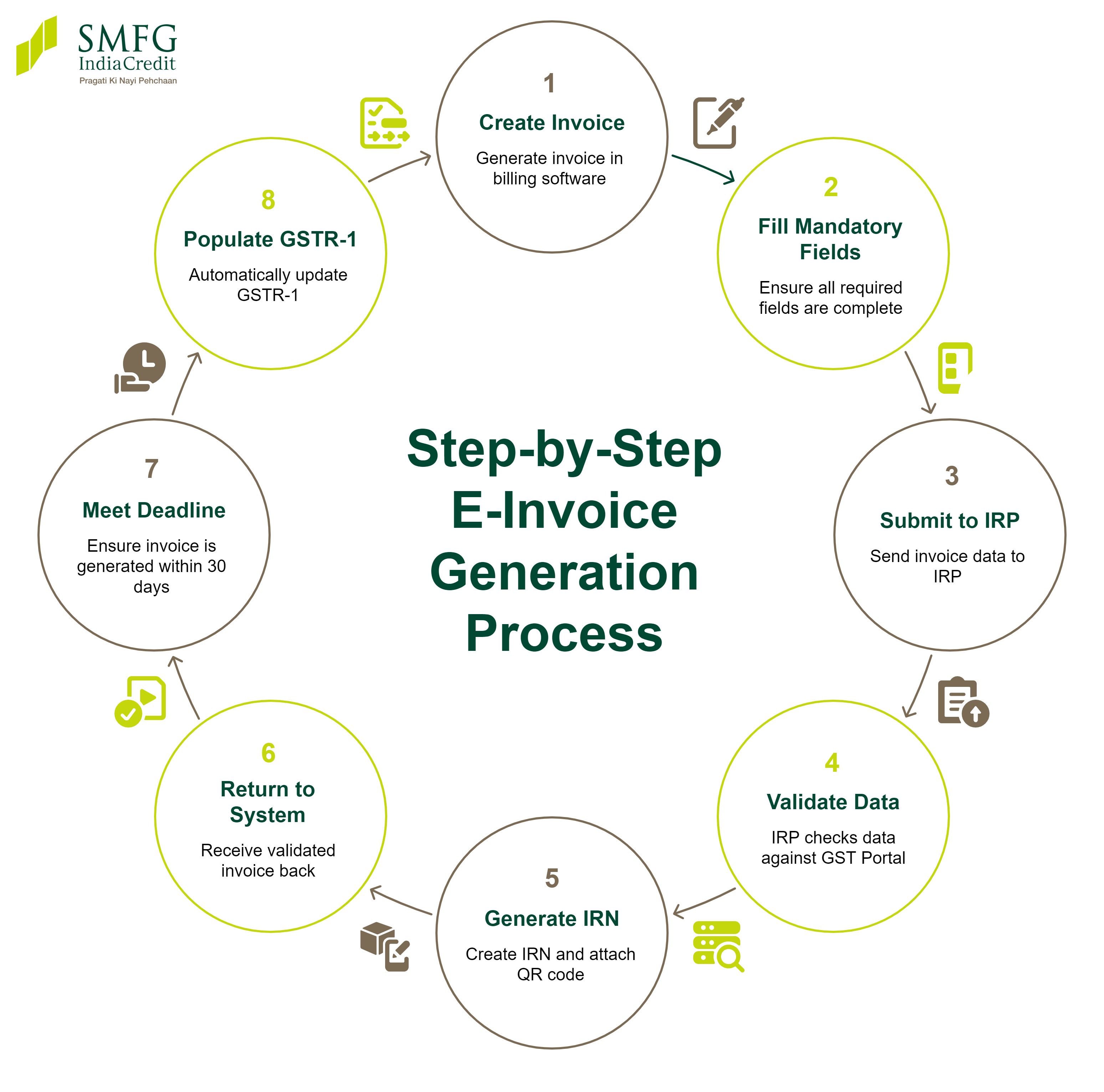
Step-by-Step E-Invoice Generation Process
Here is how to generate an e-invoice under the current provisions:
- Create the invoice in your billing software or ERP system as you normally would.
- Ensure all mandatory fields (GSTIN, HSN code, tax amounts) are filled correctly.
- Your software submits the invoice data to the IRP through the appropriate integration.
- The IRP validates the data against the GST Portal records.
- On successful validation, the system completes IRN generation and attaches a digitally signed QR code.
- The validated invoice is returned to your system and is now legally valid.
- For businesses with a Rs. 10 crore or more turnover, this must happen within 30 days of the invoice date.
- The invoice data automatically populates GSTR-1, reducing manual return filing effort.
This outlines the general GST e-invoice process, although the exact workflow may vary depending on the billing software or ERP solution used.
Common E-Invoicing Errors MSMEs Must Avoid
Getting the process wrong can result in invoice rejection and disrupted cash flow. Watch out for the following GST e-invoice mistakes:
- Incorrect GSTIN: An incorrect buyer or supplier GSTIN can result in invoice rejection by the IRP.
- Duplicate Invoice Numbers: The IRP will not accept an invoice number that has already been used for IRN generation for the same supplier and document type.
- Missing HSN Codes: All line items must include valid HSN or SAC codes.
- Delayed Reporting: Businesses with an aggregate turnover of Rs. 10 crore or more must report applicable invoices within 30 days of the invoice date. Late submissions will be rejected, and no IRN will be generated.
- Incorrect Place of Supply: This can affect GST invoice compliance and determine whether IGST or CGST/SGST is applicable to the transaction.
Penalties for Non-Compliance with E-Invoicing Rules
If you are required to generate e-invoices and do not, the consequences include:
- The invoice is treated as invalid, and the buyer cannot claim ITC on it
- An e-invoicing penalty of Rs. 10,000 or 100% of the tax due, whichever is higher, per invoice for non-issuance of a valid e-invoice
- Higher scrutiny during GST audits and assessments
- Potential ITC reversal for buyers, which can damage your business relationships
Benefits of Early E-Invoicing Adoption for MSMEs
Getting compliant early, rather than waiting for a mandate, has several business advantages. Benefits of e-invoicing include:
- Invoice data flows directly into GSTR-1, cutting manual reconciliation time
- Fewer errors in tax filings, which means a lower risk of receiving GST notices
- Faster e-way bill generation using validated invoice data
- Cleaner audit trail, which supports smoother assessments
- Improved credibility with large buyers who are already compliant
- Better chances of credit approval when lenders assess your GST digital compliance record
Strong compliance, accurate tax and financial records, and overall creditworthiness can all strengthen your borrowing profile, improving your chances of securing a competitive business loan interest rate.
Conclusion
The e-invoicing rules 2026 have not changed significantly, but the overall direction is clear. The turnover threshold has reduced steadily over the past few years, and the scope of MSME e-invoicing compliance is expected to expand over time. If your turnover is approaching Rs. 5 crore, start preparing now. Upgrade your billing software, verify your GST registration details, train your team, and conduct trial e-invoice generation before the requirement formally applies to your business.
If you need additional financial support while managing business growth alongside tax compliance obligations, SMFG India Credit offers unsecured business loans of up to Rs. 1 crore* at competitive interest rates. Check your business loan eligibility and apply online with minimal documentation.
We recommend using a business loan eligibility calculator to understand your borrowing capacity before applying.