Small businesses often struggle with maintaining detailed books of accounts and complying with complex tax requirements. Section 44AD of the Income Tax Act, 1961 simplifies this process through a presumptive taxation scheme that allows eligible taxpayers to declare income at a prescribed percentage of their turnover without maintaining extensive accounting records.
What Is Section 44AD of the Income Tax Act?
Section 44AD of the IT Act is a presumptive taxation provision introduced to simplify tax compliance for eligible small businesses. Instead of calculating taxable income based on actual profits and maintaining detailed books of accounts, eligible taxpayers can declare income at a prescribed percentage of their gross business turnover or receipts.
Income declared under this section is considered the taxable business income, and taxpayers can file their Income Tax Return (ITR) based on the presumptive income rather than computing actual profits and allowable business expenses.
Purpose of Section 44AD
The primary purpose of Section 44AD is to encourage tax compliance among small businesses by introducing a simplified method of taxation. Instead of maintaining extensive accounting records and calculating taxable income through detailed financial statements, eligible businesses can declare income on a presumptive basis.
The provision also reduces administrative costs for both taxpayers and the Income Tax Department by minimising compliance requirements while ensuring that businesses continue to report taxable income in a straightforward and transparent manner.
Key Features of Section 44AD
Section 44AD taxation includes several features that make compliance easier for eligible businesses.
- Presumptive taxation: Taxable income is calculated using prescribed percentages of gross turnover or gross receipts instead of actual business profits.
- Prescribed income rates: Income is generally presumed to be 8% of total turnover or gross receipts. If the gross receipts or annual turnover are received through an account payee cheque, draft, or prescribed electronic mode, the presumptive income is calculated at 6% of the previous year’s turnover.
- Turnover threshold: The scheme is available only if the business turnover or gross receipts remain within the turnover limit specified under the Income Tax Act for the relevant Financial Year (FY) or Assessment Year (AY).
- Simplified compliance: Eligible taxpayers are generally relieved from maintaining detailed books of accounts required under regular taxation, subject to the applicable provisions.
- Tax audit relief: Taxpayers opting for Section 44AD are generally not required to get their accounts audited under Section 44AB if they comply with the conditions.
- Advance tax benefit: Eligible taxpayers opting for Section 44AD are generally required to pay advance tax in a simplified manner instead of following the regular quarterly instalment schedule applicable to many other taxpayers.
- Reduced compliance burden: Small businesses can spend less time on accounting and tax documentation, allowing them to focus more on business operations and growth.
Eligibility Criteria Under Section 44AD
Not every business or taxpayer can opt for the presumptive taxation scheme under Section 44AD. The Income Tax Act specifies clear Section 44AD eligibility conditions relating to the taxpayer, the business, and the turnover.
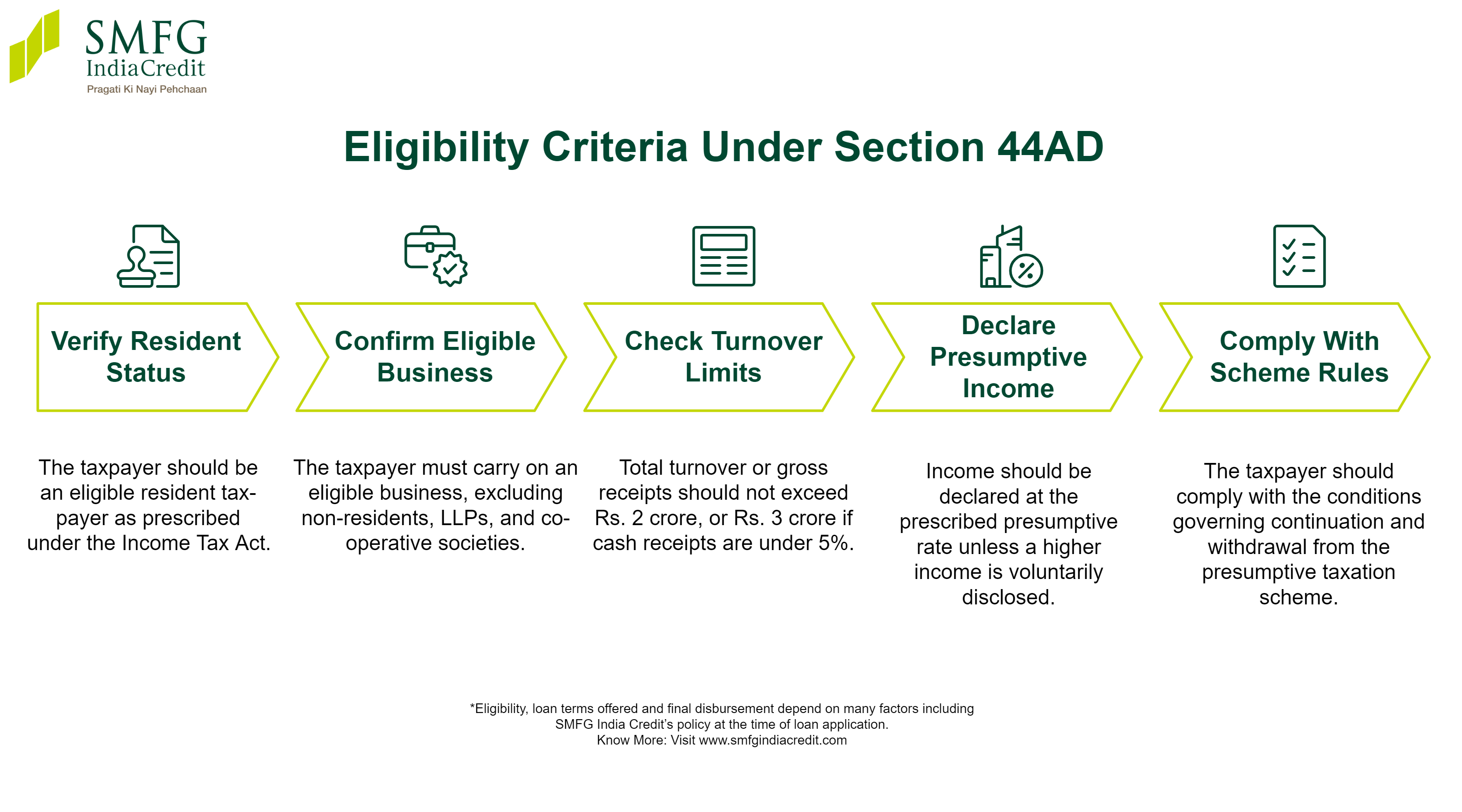
To claim the benefit, the following Section 44AD conditions generally need to be satisfied:
- The taxpayer should be an eligible resident taxpayer as prescribed under the Income Tax Act.
- The taxpayer must carry on an eligible business. Certain individuals and activities, including non-residents, LLPs, and co-operative societies, are excluded.
- Total turnover or gross receipts from the business should not exceed Rs. 2 crore in the relevant previous year. The limit is increased to Rs. 3 crore if cash receipts do not exceed 5% of total turnover or gross receipts.
- Income should be declared at the prescribed presumptive rate unless a higher income is voluntarily disclosed.
- The taxpayer should comply with the conditions governing continuation and withdrawal from the presumptive taxation scheme.
Eligible Taxpayers
Section 44AD is available to resident individuals, resident Hindu Undivided Families (HUFs), and resident partnership firms, excluding Limited Liability Partnerships (LLPs), that carry on an eligible business.
Non-resident taxpayers, LLPs, companies, and several other business entities are not eligible to opt for the scheme.
Eligible Businesses
Section 44AD generally applies to eligible businesses, subject to the prescribed turnover limits and other applicable conditions.
However, certain businesses and activities are specifically excluded from the scheme. These include the business of goods carriages covered under Section 44AE, agency businesses, businesses earning income in the nature of commission or brokerage, and professions referred to under Section 44AA(1), which may alternatively be eligible under Section 44ADA.
Applicability of Section 44AD
Section 44AD applies only when the taxpayer, business, and turnover satisfy the conditions prescribed under the Income Tax Act. Before opting for the presumptive taxation scheme, it is important to determine whether your business qualifies and whether your turnover falls within the prescribed threshold.
Under this scheme, eligible taxpayers can declare income at the prescribed presumptive rate instead of calculating actual business profits. The provision is intended for small businesses with relatively simple operations and lower compliance requirements.
The table below summarises the key applicability conditions under Section 44AD.
|
Particular
|
Under Section 44AD Applicability
|
|
Eligible taxpayers
|
Resident individuals, resident HUFs, and resident partnership firms (excluding LLPs)
|
|
Eligible businesses
|
Small businesses other than those specifically excluded under the Income Tax Act
|
|
Turnover limit
|
Subject to the prescribed turnover limit for the relevant FY
|
|
Method of taxation
|
Presumptive taxation based on prescribed profit percentages
|
|
Books of accounts
|
Detailed books are generally not required, subject to applicable provisions
|
|
Tax audit
|
Generally not required if all conditions of Section 44AD are satisfied
|
Turnover Limit Under Section 44AD
One of the most important conditions under Section 44AD is the turnover limit. Only businesses whose total turnover or gross receipts remain within the prescribed threshold can opt for the presumptive taxation scheme.
Currently, the general Section 44AD turnover limit is Rs. 2 crore for eligible businesses. However, the limit can increase to Rs. 3 crore if the prescribed conditions relating to digital transactions are satisfied. Broadly, this higher limit is available where cash receipts do not exceed the specified percentage of the total turnover or gross receipts during the financial year.
Presumptive Section 44AD Income Calculation
Generally, the presumptive income under Section 44AD is calculated as:
- 8% of turnover or gross receipts.
- 6% of turnover or gross receipts received through account payee cheque, account payee bank draft, electronic clearing systems, or other prescribed digital modes.
For example, suppose a retailer has a total annual turnover of Rs. 90 lakhs, of which Rs. 70 lakhs qualifies for the 6% presumptive rate, and the remaining Rs. 20 lakhs is received in cash.
The presumptive income would be calculated as follows:
|
Particular
|
Amount (Rs.)
|
|
Turnover qualifying for the 6% rate
|
70,00,000
|
|
Presumptive income at 6%
|
4,20,000
|
|
Cash turnover
|
20,00,000
|
|
Presumptive income at 8%
|
1,60,000
|
|
Total presumptive income
|
5,80,000
|
Understanding your taxable income under Section 44AD can be useful when exploring financing options such as a business loan. Lenders typically assess factors such as income, turnover, repayment capacity, credit profile, and financial stability when evaluating a loan application.
Enterprises using presumptive taxation should also understand the business loan documents required by the lender. Keeping relevant ITRs, bank statements, business proofs, and other applicable records ready can support smoother verification and help demonstrate the business’s financial position.
Benefits of Opting for Section 44AD
Some of the key Section 44AD benefits include:
- Simplified tax computation without calculating actual business profits.
- Reduced record-keeping requirements, as detailed books of accounts are generally not mandatory under the scheme.
- Exemption from Section 44AB tax audit, provided all applicable conditions are fulfilled.
- Simplified advance tax payment, making compliance easier for small businesses.
- Lower compliance costs, as businesses spend less time and money on accounting and audit-related activities.
- More focus on business operations, allowing entrepreneurs to concentrate on growth instead of extensive tax documentation.
Situations Where Section 44AD Does Not Apply
Although Section 44AD covers many small businesses, certain taxpayers and businesses are specifically excluded from the presumptive taxation scheme.
Section 44AD generally does not apply in the following situations:
- The taxpayer is a non-resident, company, or Limited Liability Partnership (LLP).
- The business turnover exceeds the prescribed threshold for the relevant FY.
- The taxpayer carries on an agency business.
- The business earns income in the nature of commission or brokerage.
- The taxpayer is engaged in the business of plying, hiring, or leasing goods carriages, which is covered separately under Section 44AE.
- The taxpayer carries on a profession referred to under Section 44AA(1).
- The taxpayer does not satisfy other eligibility conditions prescribed under the Income Tax Act.
Section 44AD vs Regular Taxation
While Section 44AD offers a simplified method of computing taxable income, the regular taxation system requires businesses to maintain detailed books of accounts and calculate actual profits after considering eligible expenses.
The following table highlights the key differences between the two methods.
|
Basis
|
Section 44AD
|
Regular Taxation
|
|
Method of income calculation
|
Presumptive income based on prescribed percentages of turnover
|
Actual income calculated after deducting allowable business expenses
|
|
Books of accounts
|
Generally not required, subject to applicable provisions
|
Detailed books of accounts must be maintained as prescribed
|
|
Tax audit
|
Generally not required if the conditions of Section 44AD are met
|
May be required if audit provisions under the Income Tax Act apply
|
|
Compliance burden
|
Comparatively low
|
Higher due to detailed accounting and documentation
|
|
Profit declaration
|
Income declared at prescribed presumptive rates or higher
|
Income based on actual business performance
|
|
Suitable for
|
Small eligible businesses seeking simplified compliance
|
Businesses with complex operations or lower actual profit margins
|
Things to Consider Before Opting for Section 44AD
Consider the following factors:
- Compare your actual profit margin with the presumptive income prescribed under Section 44AD.
- Confirm that your turnover is within the applicable limit for the relevant financial year.
- Verify that your business and taxpayer category are eligible under the scheme.
- Understand the implications of opting in and opting out of the presumptive taxation scheme, including the lock-in provisions.
- Assess whether reduced compliance outweighs any additional tax that may arise if your actual profits are lower than the presumptive income under Section 44AD.
Conclusion
Section 44AD for small businesses provides a simpler way for eligible taxpayers to calculate and report taxable business income. Understanding Section 44AD compliance requirements, including eligibility, turnover limits, and presumptive income rates, can help businesses meet their tax obligations appropriately.
Since individual tax circumstances can vary, consulting a Chartered Accountant (CA) can help you understand how the provisions apply to your business. Keep your Permanent Account Number (PAN) and other relevant financial and tax records readily available when filing your return.
For businesses considering external financing to support their growth efforts, SMFG India Credit offers unsecured funds of up to Rs. 1 crore* at competitive business loan interest rates.
Before applying, use the business loan eligibility calculator to get an indicative estimate of the loan amount you may qualify for and plan your borrowing accordingly.
You can also use the business loan EMI calculator to estimate potential monthly repayments based on the loan amount, interest rate, and tenure, helping you assess repayment affordability before proceeding with your application.