How to File GST Returns Online?
A Goods and Services Tax return (GST return) is a statement of your sales, purchases, tax collected and tax paid that registered businesses file with the tax department. Most businesses file monthly or quarterly through the GST portal, with an annual return on top.
Filing on time helps you claim Input Tax Credit, stay compliant and avoid late fees, and the whole process is done online.
This article covers how to file GST returns online, the common mistakes to avoid, and the benefits of filing on time.
What Is a GST Return?
A GST return is a document that every registered taxpayer files to report their business activity to the Goods and Services Tax Council department. It records your outward supplies (sales), inward supplies (purchases), the tax you have collected, the tax you have paid and the Input Tax Credit (ITC) you wish to claim.
The tax authorities use these returns to calculate the taxpayer’s net GST liability for a particular period. Filing accurate returns is an important part of GST compliance because the reported figures affect both the taxpayer’s tax credit and the Input Tax Credit claims of buyers.
Who Should File GST Returns?
If you hold a GST registration, you are required to file returns, even in a period with no business activity, when you file a nil return. Filing applies across several taxpayer types:
- Regular registered businesses filing monthly or quarterly returns
- Composition scheme dealers, who file a simpler quarterly statement and an annual return
- E-commerce operators who collect tax at source (TCS)
- Businesses required to deduct tax at source (TDS)
- Input service distributors and certain other special categories
Types of GST Returns in India
There are several GST return forms, each meant for a different purpose or taxpayer type. The most common ones are outlined below.
|
Return
|
Who Files It
|
Purpose
|
|
GSTR-1
|
Regular taxpayers
|
Details of outward supplies (sales)
|
|
GSTR-3B
|
Regular taxpayers
|
Summary of sales, ITC, and tax payable
|
|
GSTR-4
|
Composition dealers
|
Annual return for the composition scheme
|
|
GSTR-7
|
TDS deductors
|
Tax deducted at source details
|
|
GSTR-8
|
E-commerce operators
|
Tax collected at source details
|
|
GSTR-9
|
All taxpayers
|
Annual consolidated return
|
Documents Required Before Filing GST Returns
Keeping your records ready before you log in makes GST return filing online far smoother. You will usually need:
- Your GSTIN and portal login details
- Sales invoices for the period
- Purchase invoices and records for ITC claims
- Debit and credit notes, if any
- Bank account details
- Accounting or billing software reports summarising the data
Maintaining organised financial and compliance records not only simplifies online GST return filing but can also help when preparing business loan documents required by lenders if you apply for financing in the future.
How to File GST Returns Online?
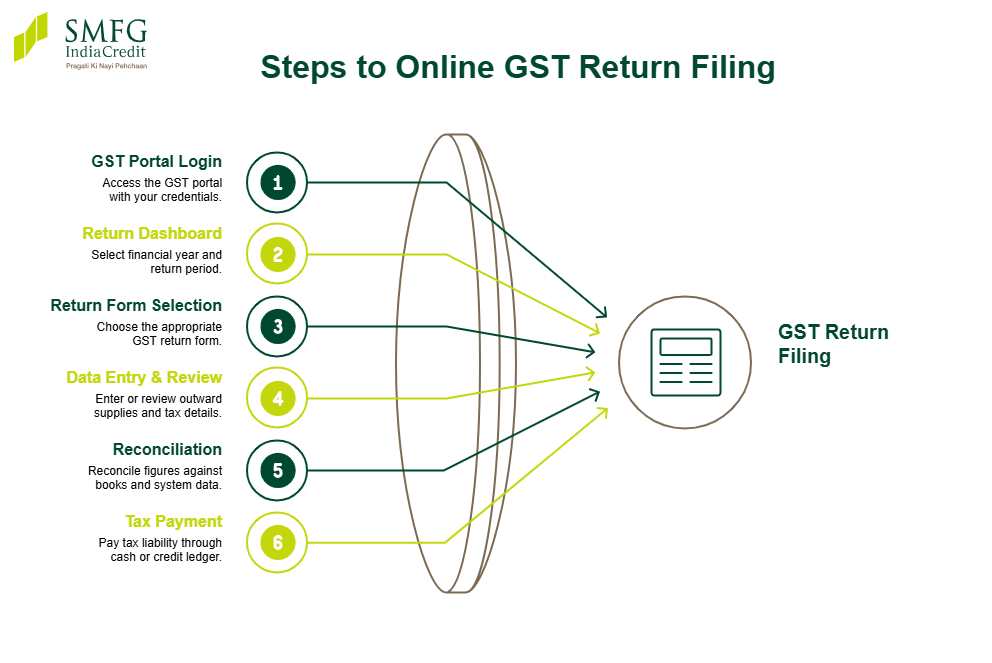
Filing GST returns is fully online through the official portal. The broad GST return process is the same across return types, although the specific details vary depending on the form being filed.
- Visit the GST portal and log in with your username and password.
- Go to the 'Returns Dashboard' and select the relevant financial year and return period.
- Choose the return form you need to file, such as GSTR-1 or GSTR-3B.
- Enter or review the details, including outward supplies, ITC and tax payable.
- Reconcile the figures against your books and the system-generated data.
- Check your tax liability and pay any amount due through the cash or credit ledger.
- Submit the return and complete verification using a DSC or EVC.
Once the GST return filing steps are completed, you can download the acknowledgement receipt for your records. Timely and accurate filing helps maintain proper compliance and organised financial records, which can also support future applications for financial products such as a business loan.
How to File GSTR-3B Online?
GSTR-3B is the summary return that most businesses file every month or quarter. So it is worth knowing the steps of GSTR-3B filing:
- Log in and open GSTR-3B for the chosen period from the Returns Dashboard.
- Review the auto-populated sales and ITC figures drawn from GSTR-1 and GSTR-2B.
- Add any remaining details the system asks you to confirm.
- Check the tax liability and offset it using available ITC and cash balance.
- Save, preview and submit the return, then verify with DSC or EVC.
Note that key auto-filled fields in GSTR-3B are now locked, so corrections must be made in GSTR-1A before you file.
GST Return Filing Due Dates
GST return due dates depend on the return type and whether you file monthly or quarterly. The common timelines are shown below.
|
Return
|
Frequency
|
Typical Due Date
|
|
GSTR-1
|
Monthly
|
11th of the next month
|
|
GSTR-1 (QRMP)
|
Quarterly
|
13th of the month after the quarter
|
|
GSTR-3B
|
Monthly
|
20th of the next month
|
|
GSTR-3B (QRMP)
|
Quarterly
|
22nd or 24th of the month after the quarter, based on the place of business
|
|
GSTR-4
|
Annual
|
30th June, after the financial year
|
|
GSTR-9
|
Annual
|
31st December of the next financial year
|
Dates can be extended by government notification, so check the portal close to your deadline.
Late Fees and Penalties for Delayed GST Return Filing
Filing late attracts both a late fee and interest, which add up quickly. As a quick reference:
|
Charge
|
Details
|
|
Late fee (regular return)
|
₹50 per day (₹25 CGST + ₹25 SGST)
|
|
Late fee (nil return)
|
₹20 per day (₹10 CGST + ₹10 SGST)
|
|
Interest on tax due
|
18% per year on the outstanding amount
|
GST return penalties are also subject to maximum caps, which may vary depending on the return type and the taxpayer’s turnover category. Beyond the cost, delayed filing can block later returns and hold up your buyers' ITC, so timely filing protects both you and your customers.
Common Mistakes to Avoid While Filing GST Returns
A few recurring errors cause most filing problems. Watch out for these:
- Mismatches between the sales reported in GSTR-1 and GSTR-3B
- Entering an incorrect GSTIN for a customer or supplier
- Missing or wrongly claiming ITC
- Filing the wrong return form for your registration type
- Leaving returns until the last day and risking a delay
Benefits of Filing GST Returns on Time
Timely filing does more than keep you on the right side of compliance. The main gains include:
- Avoiding late fees and interest charges
- Smooth, uninterrupted ITC for you and your buyers
- Easier access to credit, as clean filings support loan and tender applications
- Less risk of notices, blocked returns, and audit scrutiny
Latest GST Return Filing Updates
The GST system has tightened notably over 2025 and into 2026. Auto-populated liability fields in GSTR-3B are now hard-locked and non-editable, with corrections routed through GSTR-1A. Sales figures in Tables 3.1 and 3.2 are no longer editable in GSTR-3B.
A major change is the three-year time bar: from the start of 2026, GSTR-1 returns older than three years from their due date can no longer be filed, after which the period is permanently blocked.
As GST rules and portal functionalities may continue to evolve through government notifications and Goods and Services Tax Network advisories, taxpayers should regularly check the official GST portal for the latest updates and compliance requirements.
Conclusion
A GST return reports your sales, purchases, and tax to the authorities, and filing it accurately is central to running a compliant business. With most returns filed online, the process is straightforward once your records are in order. Meeting your due dates protects your ITC, avoids penalties and keeps your compliance record strong, which pays off whenever you seek finance or new business.
If your business requires additional financial support to manage working capital needs alongside GST obligations, SMFG India Credit offers unsecured financing of up to Rs. 1 crore* at competitive business loan interest rates.
Estimate your repayments using our business loan EMI calculator and submit your application through a convenient online process.