Quick Summary
- A GST notice is an official communication from the GST department asking you to clarify, correct, or justify something related to your tax filings.
- Common triggers include return mismatches, delayed filings, and incorrect Input Tax Credit (ITC) claims.
- As of 2024, Section 74A of the CGST Act introduced a unified time limit for issuing GST demand notices or orders for FY 2024–25 onwards and extended the reduced-penalty window from 30 to 60 days.
- If you receive a GST compliance notice, respond within the prescribed deadline and provide the required information or clarification.
- Failing to respond to a GST Portal notice, where required, can lead to penalties, GST registration cancellation, or legal action.
A GST notice is an official communication issued by the tax authorities to help ensure compliance with GST laws and regulations. Understanding what a GST notice is can help businesses respond appropriately and avoid unnecessary penalties or disputes. A notice from the GST department may be issued for reasons such as return mismatches, delayed filings, or additional information requests.
This guide explains the types of GST notices, the circumstances in which they are issued, and the GST response process to help businesses address them correctly and within the prescribed timelines.
What Is a GST Notice?
Under the Goods and Services Tax framework in India, tax authorities may issue a GST notice when they require clarification, identify a discrepancy, or detect a compliance-related issue in a taxpayer's registration or filings. A GST tax notice does not necessarily mean that you have violated any provisions of the law. In many cases, it is simply a request for additional information or supporting documents. However, every GST department notice should be reviewed carefully and addressed within the prescribed timeline.
Reasons for Receiving GST Notices
There are several reasons you might receive a notice from the GST department. The most common include:
- GST Filing Discrepancies: Mismatches between the data reported in GSTR-1 and GSTR-3B.
- Input Tax Credit (ITC) Mismatches: ITC claimed does not match the details available in GSTR-2A or GSTR-2B.
- Delayed or Non-filing of Returns: GST returns are not filed within the prescribed timelines.
- GST Compliance Errors: Incorrect tax calculations, short payment of tax, or incorrect refund claims.
- GST Department Audit Notice: Tax authorities conduct an audit of your records to verify compliance.
- Registration Discrepancies: Incorrect or incomplete information submitted during GST registration.
- Export Data Mismatches: GSTR-1 details do not align with records available on the ICEGATE portal.
Types of GST Notices
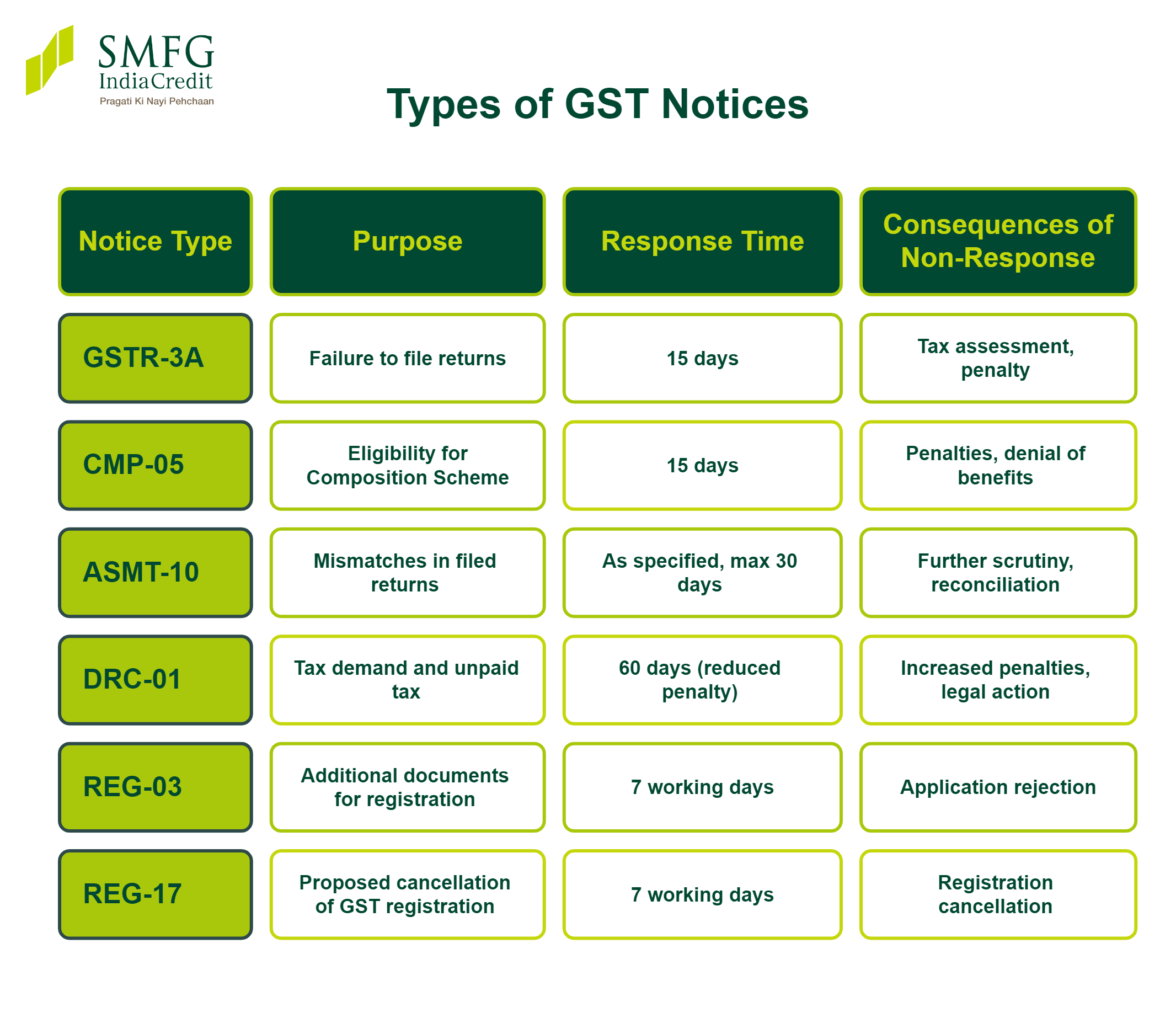
There are multiple GST notice formats under the Goods and Services Tax law, each serving a different purpose. Here are the key types of GST legal notices you should know.
GSTR-3A Notice
A GSTR-3A notice is a GST return notice issued when you fail to file your returns, specifically GSTR-1, GSTR-3B, GSTR-4, or GSTR-8. It is one of the most frequently issued GST notices.
You have 15 days from receipt to file the pending returns along with applicable late fees and interest. If you do not respond, tax authorities can assess your tax liability based on available information and charge a penalty of Rs. 10,000 or 10% of the tax due, whichever is higher.
CMP-05 Notice
The CMP-05 notice is issued when the GST department questions whether you are eligible to remain under the Composition Scheme. You need to justify your eligibility within 15 days of the GST Composition Scheme notice. Non-response can lead to penalties under Section 122 and denial of Composition Scheme benefits.
ASMT-10 Notice
The ASMT-10 is a GST scrutiny notice issued when tax authorities find mismatches or inconsistencies during a review of your filed returns. You need to provide a clarification or supporting documents to resolve the GST filing discrepancies flagged in the notice. The timeline is as specified in the GST discrepancy notice, or a maximum of 30 days from the date of service of the notice. This is one of the more detailed GST notices and often requires reconciliation data.
DRC-01 Notice
The DRC-01 is a GST demand notice. It is a show-cause notice issued when tax authorities determine that tax is due and unpaid, whether due to fraud, misstatement, or genuine error. Under the revised Section 74A introduced in Budget 2024, the window to pay the demanded tax at a reduced penalty has been extended from 30 to 60 days. Respond to this tax liability notice without delay to avoid future complications.
REG-03 Notice
The REG-03 is a GST registration notice issued during the registration or amendment process. The GST department may ask for additional documents or clarification. You must reply using Form REG-04 within 7 working days. If you miss the GST response deadline, your application may be rejected via REG-05.
REG-17 Notice
The REG-17 is a GST cancellation notice issued when tax authorities propose to cancel your GST registration. You must file your reply in Form REG-18 within 7 working days, explaining why your registration should be retained. Failure to respond results in cancellation of GST registration under REG-19.
Other Important GST Notices
Beyond the ones above, there are other GST compliance notices you may encounter:
- GST 46 Notice: Issued under Section 46 of the CGST Act for failure to file returns. It precedes a best judgment assessment.
- MOV notices: Issued during goods-in-transit inspections, particularly related to e-way bill violations.
- Audit notices (ADT series): Part of a GST department audit notice process, where officers review your books of accounts over a defined period.
- RFD-08: A show-cause notice for refund rejection, requiring a reply within 15 days.
You can access and conduct a GST notice download for all of these directly from the GST Portal under the "Services" section after logging in.
GST Notice Response Time Limits
Response timelines vary depending on the type of GST notices you receive. Here is a quick reference to the GST compliance timeline:
|
Notice Type
|
Purpose
|
GST Response Deadline
|
|
GSTR-3A
|
Non-filing of returns
|
15 days from receipt
|
|
CMP-05
|
Composition scheme eligibility
|
15 days from receipt
|
|
ASMT-10
|
Return scrutiny and discrepancies
|
As specified in the notice, or up to 30 days from receipt
|
|
DRC-01
|
GST demand notice/tax liability
|
60 days
|
|
REG-03
|
Registration clarification
|
7 working days
|
|
REG-17
|
GST registration cancellation
|
7 working days
|
|
RFD-08
|
Refund rejection
|
15 days from receipt
|
How to Respond to a GST Notice: Step-by-Step Process
Here is how to respond to GST notice submissions correctly:
- Log in to the GST Portal using your credentials.
- Go to "Services" and select "User Services," then click on "View Notices and Orders."
- Identify the notice and do a GST notice download to read the full document.
- Gather the documents required: invoices, filed returns, ITC reconciliation statements, and tax payment proofs.
- Draft your reply addressing each point raised in the notice.
- Upload your response and supporting documents through the portal.
- Submit and save the acknowledgement number for your records.
- Track the GST notice response status under the same section.
A proper GST notice online reply filed within the deadline protects you from further escalation.
How to Reply to GST Notice Online Through the GST Portal
After reviewing, you can reply to the GST notice online through the official GST Portal by accessing the relevant communication and following the response option available for the same. The GST portal notice response process generally involves:
- Log in to the GST Portal.
- Go to Services > User Services > View Notices and Orders.
- Open the relevant notice and select the available reply option.
- Enter the required details, upload supporting documents (if applicable), and submit your response within the prescribed deadline.
Documents Required to Respond to a GST Notice
Depending on the type of notice, you will typically need the following GST response documents or compliance proofs:
- Filed GST returns (GSTR-1, GSTR-3B, GSTR-2A)
- Purchase and sales invoices
- ITC reconciliation statements
- Tax payment challans and proofs
- Compliance filing records and audit reports
- Bank statements (if payment-related discrepancies are involved)
- Any correspondence previously sent to or received from tax authorities
Maintaining accurate GST records and responding to notices on time can strengthen your financial documentation and demonstrate better compliance. These factors can support a smoother application process when applying for a business loan, as lenders often review the financial health and regulatory compliance of an enterprise to assess lending risk.
Having all relevant financial paperwork organised, including tax returns, financial records, and bank statements, can help you better prepare the required business loan documents, saving time and effort during the application process.
GST Notice Consequences: What Happens If You Do Not Respond?
Consequences of Ignoring a GST Notice
Ignoring GST notice consequences include:
- Tax authorities may assess your liability based on available data, which can result in a higher demand than what you actually owe
- A GST recovery notice may be issued to recover outstanding dues, including interest
- Your GST registration may be suspended or cancelled
- Legal proceedings may be initiated in cases of wilful non-compliance
GST Notice Penalty
The GST notice penalty structure depends on the type of non-compliance. For example, non-filing of GSTR-3A can result in GST non-compliance penalties of Rs. 10,000 or 10% of the tax due, whichever is higher. Other GST legal consequences include interest on unpaid tax, applicable late fees, and other penalties, depending on the circumstances.
Can GST Registration Be Cancelled for Non-Response?
Yes, in certain cases. If you do not reply to a REG-17 notice within 7 working days, the GST department may cancel your registration through REG-19. GST registration cancellation affects your ability to collect GST from customers, claim ITC, and operate legally as a registered business. You can apply for revocation, but the process involves additional compliance steps and is not guaranteed.
Tips to Avoid Receiving GST Notices
Staying ahead of GST compliance errors is far easier than dealing with notices after the fact. Here is what helps to avoid GST notices:
- File all returns (GSTR-1 and GSTR-3B) on time, every month
- Reconcile your ITC claims against GSTR-2B before filing
- Cross-check your e-way bill data with GSTR-1 figures regularly
- Maintain complete and accurate records of all invoices and payments
- Conduct internal audits at least once a quarter to catch discrepancies early
- Respond promptly to any GST compliance notice, even if you think it was sent in error
Following these GST compliance tips as part of your regular tax processes can help reduce errors and avoid unnecessary notices.
Conclusion
GST notices are a routine part of operating a GST-registered business in India. Most of them are manageable if you respond on time with the right documents. The key is not to ignore them. Whether it is a GSTR-3A for non-filing, a DRC-01 GST demand notice, or a REG-17 for registration cancellation, every notice has a deadline and a process.
If you need working capital support as you manage GST obligations along with routine operations, SMFG India Credit offers unsecured funds of up to Rs. 1 crore* at competitive business loan interest rates.
Check your business loan eligibility and apply online today.