Section 44AB of the Income Tax Act, 1961, lays down the rules for conducting a tax audit for eligible businesses and professionals. If your turnover or gross receipts cross the prescribed limits, Section 44AB requires you to get your accounts audited by a Chartered Accountant (CA) and submit the prescribed audit report. This guide explains what Section 44AB is, its applicability, audit limits, due dates, penalties, and compliance requirements.
What Is Section 44AB of the Income Tax Act?
Section 44AB is a provision under the Income Tax Act, 1961 that makes an income tax audit mandatory for specified businesses and professionals once they cross the prescribed financial thresholds. The objective of this provision is to improve tax compliance by ensuring that books of accounts accurately reflect income, deductions, and tax liabilities. The income tax audit under Section 44AB also helps the tax department verify the correctness of the information reported in the Income Tax Return (ITR).
Sec 44AB of the Income Tax Act applies to different categories of taxpayers based on their business turnover, gross receipts, and the applicable taxation scheme. The Section 44AB tax audit must be conducted by a Chartered Accountant (CA), who prepares and files the prescribed audit report electronically.
Who Is Covered Under Section 44AB?
Section 44AB of the Income Tax Act covers taxpayers carrying on business or profession whose turnover or receipts exceed the prescribed limits. It also applies in certain cases involving the Presumptive Taxation Scheme, where taxpayers declare income below the specified percentage under Section 44AD, Section 44ADA, or Section 44AE. Since tax audit applicability depends on the nature of income and applicable provisions, reviewing your financial records each year helps you determine if an audit is required.
Applicability of Tax Audit Under Section 44AB
The applicability of Section 44AB depends on your business activity, professional receipts, and the taxation scheme you follow. The audit requirement under the Income Tax Act differs for businesses, professionals, and taxpayers opting for presumptive taxation. The Section 44AB audit limit has also been revised over the years to encourage digital transactions, making it important to check the latest thresholds before filing your return.
|
Taxpayer Category
|
Tax Audit Applicability
|
|
Business (regular taxation)
|
Audit required if business turnover exceeds Rs. 1 crore. The tax audit turnover limit increases to Rs. 10 crore if cash receipts and payments do not exceed 5% of total transactions.
|
|
Professionals
|
Tax audit for professionals applies if gross receipts exceed Rs. 50 lakhs during the financial year.
|
|
Taxpayers under Section 44AD
|
Audit may apply if income declared is below the prescribed rate and taxable income exceeds the basic exemption limit.
|
|
Taxpayers under Section 44ADA
|
Audit may apply when profits declared are below the prescribed percentage and taxable income exceeds the exemption limit.
|
|
Taxpayers under Section 44AE
|
Audit requirements depend on the prescribed conditions under the relevant provision.
|
Turnover Limits for Businesses
For tax audit for businesses, Section 44AB generally applies when your business turnover exceeds Rs. 1 crore during a financial year. If your cash receipts and cash payments remain within 5% of total transactions, the income tax audit threshold increases to Rs. 10 crore. This higher tax audit turnover limit promotes digital transactions while reducing the compliance burden for eligible businesses.
Gross Receipt Limits for Professionals
For professionals, Section 44AB applies when gross receipts exceed Rs. 50 lakhs in a financial year. This income tax audit threshold covers professionals such as doctors, architects, lawyers, consultants, and other eligible practitioners. If your receipts exceed the prescribed limit, a tax audit for professionals becomes mandatory.
Cases Involving Presumptive Taxation
Taxpayers opting for the Presumptive Taxation Scheme under Section 44AD, Section 44ADA, or Section 44AE may also fall under Section 44AB in specific situations. A presumptive taxation tax audit may become applicable if profits are declared below the prescribed limits and the relevant income conditions are met. Reviewing your eligibility each financial year helps ensure timely Section 44AB compliance and avoids unnecessary penalties.
Tax audit compliance can also become relevant when applying for credit products such as a business loan. Lenders may review audited financial statements, ITRs, turnover, profitability, and other financial records to assess the business’s financial position and repayment capacity.
Depending on the lender and applicant profile, audited financial records may form part of the business loan documents required during evaluation. Keeping tax audit reports and related financial records accurate and up to date can help support smoother documentation and verification during the loan application process.
Tax Audit Report and Forms Required
Once Section 44AB becomes applicable, you need to get your accounts audited by a CA. After completing the audit, the CA prepares and electronically files the tax audit report in the prescribed format. The report is submitted using Form 3CA or Form 3CB, along with Form 3CD, depending on your audit requirements. These forms provide the Income Tax Department with details of your financial statements, tax adjustments, deductions, and other disclosures required under the Income Tax Act, 1961.
|
Form
|
Applicability
|
Purpose
|
|
Form 3CA
|
When your accounts are already audited under another law (for example, the Companies Act)
|
Certifies the existing audit and is filed along with Form 3CD
|
|
Form 3CB
|
When no statutory audit has been conducted under any other law
|
Serves as the tax audit report under the Income Tax Act and is filed with Form 3CD
|
|
Form 3CD
|
Applicable with both Forms 3CA and 3CB
|
Contains detailed particulars relating to income, deductions, depreciation, expenses, and other tax disclosures
|
Due Date for Filing Tax Audit Report
If Section 44AB applies to you, the tax audit due date is generally 30 September of the relevant assessment year. Taxpayers involved in specified international or domestic transactions generally have a due date of 31 October.
Since the Central Board of Direct Taxes (CBDT) may announce extensions in certain years, it is advisable to check the latest notifications before filing your Income Tax Return (ITR) and audit report. Filing your audit report within the prescribed timeline helps ensure smooth Section 44AB compliance and reduces the chances of penalties.
For those exploring external financing, timely compliance, coupled with a healthy cash flow and strong creditworthiness, can help improve eligibility and increase the chances of qualifying for a competitive business loan interest rate.
Penalty for Non-Compliance with Section 44AB
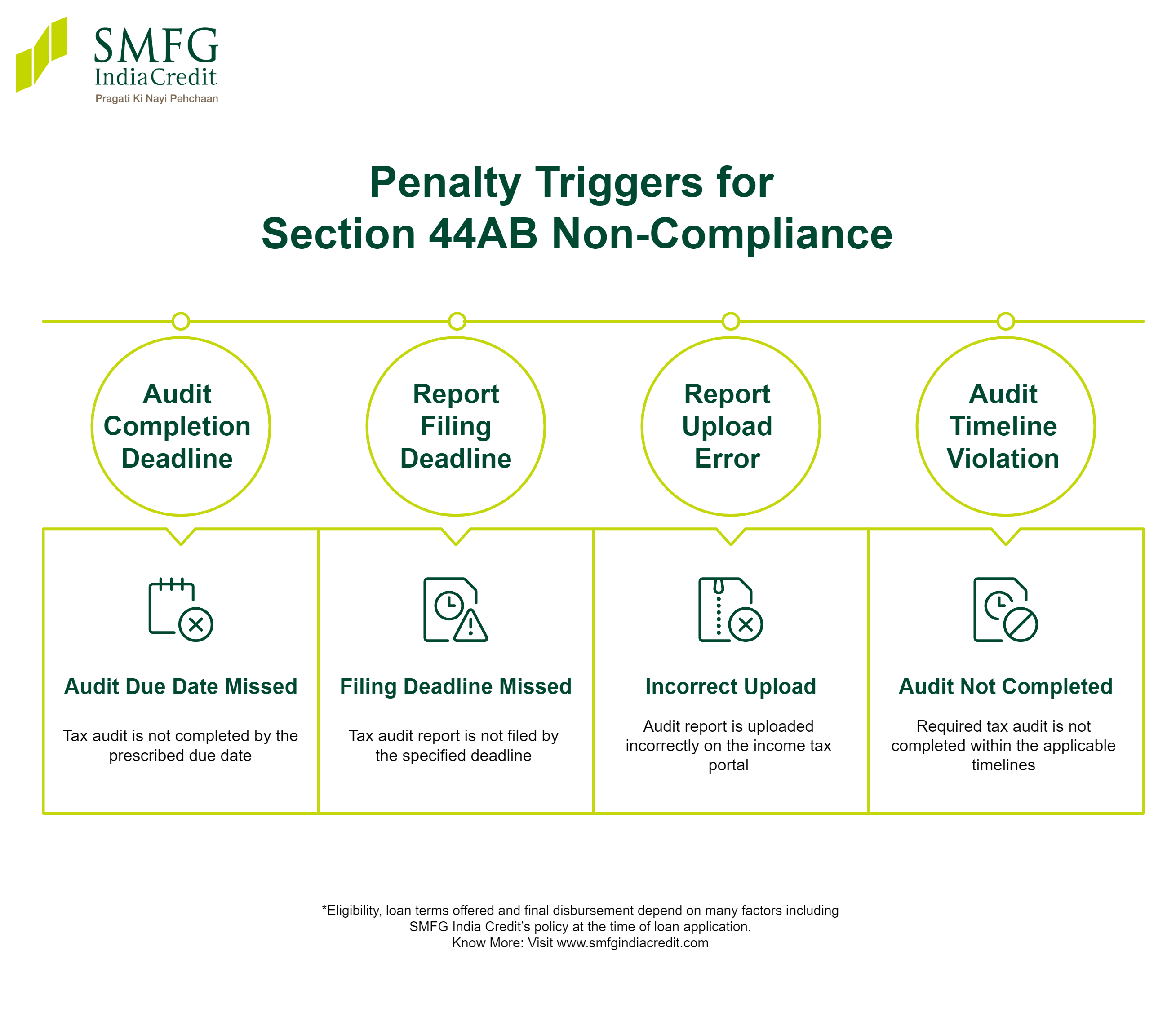
If you are required to complete an audit under Section 44AB but miss the prescribed compliance requirements, a tax audit penalty under Section 271B applies. The penalty is calculated as 0.5% of your total sales, turnover, or gross receipts, subject to a maximum of Rs. 1,50,000. In cases where a genuine and reasonable cause is established, relief may be available.
A penalty may apply in the following situations:
- The audit is completed after the prescribed due date.
- The tax audit report is filed after the deadline.
- The audit report is uploaded incorrectly on the income tax portal.
- The required audit is not completed within the applicable timelines.
Reasonable causes generally accepted for relief include:
- Serious illness or passing away of the taxpayer or auditor.
- Natural calamities affecting business operations.
- Loss of books of accounts due to circumstances beyond control.
- Resignation or unavailability of the tax auditor.
- Technical issues supported by valid documentation.
How to Stay Compliant with Section 44AB
Meeting the requirements of Section 44AB becomes much easier when you maintain accurate financial records throughout the year and review your audit applicability before the filing deadline. Planning ahead also gives your CA enough time to prepare and submit the audit report correctly.
Here are a few ways to stay compliant with Section 44AB:
- Maintain updated books of accounts throughout the financial year.
- Monitor your business turnover and gross receipts regularly to assess tax audit applicability.
- Review your eligibility under Section 44AD, Section 44ADA, or Section 44AE if you have opted for the Presumptive Taxation Scheme
- Keep supporting documents, invoices, and financial records organised.
- Share your records with your CA well before the tax audit due date.
- Ensure your tax audit report is filed in Form 3CA or Form 3CB, along with Form 3CD, within the prescribed timeline.
- Verify all disclosures before filing your Income Tax Return (ITR) to support smooth Section 44AB compliance.
Conclusion
Section 44AB plays an important role in promoting transparent financial reporting and timely tax compliance for businesses and professionals. By reviewing the latest Section 44AB audit limit, maintaining proper books of accounts, and filing the audit report before the due date, you can complete your compliance requirements on time. Since tax audit provisions may change through amendments or official notifications, it is always advisable to check the latest updates issued by the Income Tax Department before filing your return.
If you need additional funds to manage seasonal expenses or support business growth, SMFG India Credit offers unsecured business loans of up to Rs. 1 crore*.
Use our business loan EMI calculator to estimate your potential monthly repayments based on the loan amount, interest rate, and tenure before you apply online.
Our business loan eligibility calculator can also help you estimate your borrowing capacity and make application decisions accordingly.